-
"Outside of the novel setting, the individual multiplayer games have nothing substantial to offer a person other than progression. This is pretty ordinary stuff.<br />
<br />
There are so many things to do in the actual game that you'd want to do with other people: you'd want to play horsehoes, or Poker, or Blackjack. Even those would be diversions, though. You'd want to drive cattle, or steal them; you want to cut a slice of that country out and see what you could make of it – or get yours riding rough over the smaller towns. As it stands, you're given desperately limited access to a sterile, stricken place without heart or memory." (RDR is great, no question of that, but I think Tycho's right about the missed opportunities of Free Roam. More on this in a proper blog post, coming soon). -
"Now, the cordial racist shopkeeper and I have a relationship. Every five days I return to Armadillo; he warmly greets me, and I kill him. I've even found ways to avoid tedium. Sometimes a single shot to the head does the trick; other times I lasso and hogtie him before letting him have it. If I've had an especially bad day on the range, I let him tell me about the Jews before plugging him multiple times in the piehole, courtesy of my Dead Eye slo-mo skill. Occasionally I even shoot up the store. I guess you could say I'm a loyal customer." And still the myth of Rockstar's "open-world" is punctured by rendering players impotent against things they – rather than their character – have a problem with.
-
"Do you see this? It's the world's tiniest open-source violin." Yes.
-
"When I look at the iPad, I see something my dad could use without hand-holding to find the history of that banjo, to seek out those screws, to look at old video of Sonny Terry, to feed his glorious practical creativity, unencumbered by the need to learn the habits and quirks of computing, and not relying upon a transatlantic support department. There’s a liberation in open things (and opening things) but there’s a far greater one in how things can open up people." Nick Sweeney is right.
-
"Players stand in front of a green screen while the game films them and creates a music video background while they sing. Their performance is then emailed to them or burnt onto a DVD players can take home." Awesome. Unfortunately, the project has been canned. Still, it's worth watching the slightly cringey videos of the developers playing it, because it's a nifty bit of code.
-
"It all boils down to a Ruby script that runs on OS X only and uses OS X’s really awesome typography and subpixel antialiased font rendering. Why not tap into this to make those headline graphics? With Rubycocoa you can easily whip up a small app that draws some text, and save it into a PNG file." Um, blimey.
-
Icebergs and Shorelines; I love the Icebergs series particularly. What a rich page for a gallery.
-
"3. Take Notice: Be curious. Catch sight of the beautiful. Remark on the unusual. Notice the changing seasons. Savour the moment, whether you are on a train, eating lunch or talking to friends. Be aware of the world around you and what you are feeling. Reflecting on your experiences will help you appreciate what matters to you." All very good advice – and, frankly, what I knew already – but this one felt particularly appropriate, given Noticings.
-
This is a pretty good guide – made sense, got me up and running fast, and nice and clearly written.
-
"In a sense, a child, by definition, shrinks Scribblenauts’ scope: the game’s potential solutions are necessarily limited by vocabulary, so players with a smaller vocabulary have fewer options open to them. But, free of the dry, efficient logic of adulthood, a child’s imagination also opens the game up in ways beyond most adults’ reach." Simon makes a strong point about Scribblenauts.
-
"I’m not arrogant enough to believe these terms will catch on but I might start to use them just for shits and giggles. But perhaps the next time you hear someone mention that X title is linear or non-linear, before jumping down their throat ask yourself “What kind of linear are they actually talking about”."
-
Pup ponders the heat-death of the universe. Beautiful, and a lovely use of space, too.
-
"CRM training encompasses a wide range of knowledge, skills and attitudes including communications, situational awareness, problem solving, decision making, and teamwork; together with all the attendant sub-disciplines which each of these areas entails. CRM can be defined as a management system which makes optimum use of all available resources – equipment, procedures and people – to promote safety and enhance the efficiency of flight operations."
-
Scrapes lots of things, produces a useful page which actually manages to stay up. Also, it spells TRANSPORT CHAOS the only way it should be spelt: in capitals.
-
Named for the year the BJP was founded; nicely written, and not just a fast-moving press release stream.
-
All Kenta Cho's code on wonderfl.
-
Kenta Cho's making stuff on wondfl, in ActionScript. This example is ASCII-based bulletty goodness.
-
"So perverse as it might sound, I'm going to plead for less choice in video games. It's a paradox: by limiting the player's discretion, you can expand the narrative possibilities of the medium. Coercion can create a kind of emotional heft that you can't achieve within the confines of the empowerment-myth." All true, and FC2 is a fantastic example of this. But: this is just one way of making games. More of this, yes, but don't forget all the other approaches.
-
"write Actionscript3 code in a textarea, and your code will be compiled server side. Your compiled Flash will be reloaded automatically in the right side of the page, so write code and see it real-time." And you can fork other people's code. It's like github and Heroku all at once, but for Flash.
-
"These sketches should make Arduino-based web-controlled home automation, and remote-responsive spaces a lot easier. The advantage of working with an ethernet shield is that you no longer need to tether the Arduino to a computer in order to access Pachube and other network services!" Some useful examples, to be returned to.
-
"In one moment the game had broken the tacit agreement between us. It had failed to respect my character decisions, it had made a pretense of allowing me to define whether Faith violent or not only to pull the rug away at the vital moment and strip all control from me. It lied. Any actions I might have taken to avoid combat up to then were for nothing. It had failed to show me respect so had lost mine." Breaking the unwritten contract with the player is definitely a bad thing, and I didn't notice this – but only because I'd not been aiming for the "no kills" achievement.
-
Japanese Bioshock commercial. Nifty: no in-game footage, but there's something that feels like it overlaps right.
-
"Economics has been defined as the science of distributing limited means among unlimited and competing ends. On 12th April, with the arrival of elements of the 30th U.S. Infantry Division, the ushering in of an age of plenty demonstrated the hypothesis that with infinite means economic organization and activity would be redundant, as every want could be satisfied without effort." Remarkable article; fascinating for its subject matter, when it was written, what it describes, and the patterns that hold up inside such a regimented economy. A must-read, really – can't believe it took me so long to get around to it.
-
"Our attempts to bridle the player's freedom of movement and force our meaning onto him are fruitless. Rather, it is a distinct transportative, transformative quality– the ability of the player to build his own personal meaning through immersion in the interactive fields of potential we provide– that is our unique strength, begging to be fully realized." Some great Steve Gaynor; reminds me of Mitch Resnick's "microworld construction kits" all over again.
-
"It's an easy, irresistible, almost childish pleasure: the ground meat dissolved into a dark blood-red sauce until they are one and the same; no hacking, slicing or cutting needed; a slurpy goodness; the oily bolognese hanging on to the slippery pasta; guaranteed joy in a world that's just ruled it out." Recipes for ragu.
-
"Suddenly, instead of Pong, Nolan Bushnell unleashes a stark, monochrome rescue challenge on the world. AVOID MISSING PRINCESS FOR HIGH SCORE burns itself into the brains of a generation. A couple of sequels expand the world of this strange new hero and, keen to bring its popularity to bear on the 2600, Atari execs strong-arm Warren Robinett into populating Adventure with mushroom monsters and making the green dragon friendly." Delightful alterna-history from Margaret in her Offworld column.
-
"Soon enough, amid the daily grind of his obsession, he would see in the game itself a way out of the bleak hole he had fallen into. He would take a clear-eyed, calculating look at what he and his fellow players had been doing all those months—at the countless hours they'd given over to the pursuit of purely virtual but implacably scarce commodities—and he would recognize it not just for the underexploited form of productivity it was but for the highly profitable commercial enterprise it might sustain." Fantastic article from Julian Dibbell on IGE, the massive real-money trading operation.
-
"We will both have to take responsibility for our consumption. A product that keeps working for longer uses less-resources in the end. The key ingredient to all this is quality. To make something well, you know, the best you can do. To go the extra mile that it takes to do that. Every stitch, every zip, every little feature considered. The weakest points made strong. Then, and only then, have we made something that will last the test of time. Guaranteed for a minimum 10 years. Each product will come with a hand me down contract. You will sign who you want to leave the product to. This is legally binding."
-
"Trust begins when I can see the design intention of an application." Great stuff from Rands on how sync should work – namely, in the dumbest way possible – and what building trust into application design looks like.
-
"Throughout most of the year, gaming is distraction and entertainment. November separates the proverbial patriarchs from their upstart offspring. In November, the Gamer! and the With Job! blur. I spend my ill-defined work hours thinking, talking and writing about games. And the time I'm playing games become a form of work – a struggle to keep up no less frenetic than that of the clock-manager in Metropolis." This year's November release schedule was crazier than most, too.
-
"the brains behind the siduhe bridge decided to ignore all those options and break another record instead. they attached the 3200ft cables to rockets and accurately fired them over the valley, becoming the first people to do so." Woah. The photographs are awesome.
-
"We've seen this all before… [but] these Smule globes seem strangely different and much more interesting, largely I think because you hold the phone in your hand instead of the laptop or monitor on your desk. It's a more personal, touched engagement with the screen that makes visualizing an earth-spanning army of phone lighters and flute blowers more physically personal."
-
"But succeed or fail, my awareness of game design is omnipresent, and I like it that way. It enriches my experience of playing. The in-world experience remains my first thought, but my second thought is nearly always focused on the system, especially when that system demonstrates originality or beautiful execution. I don't think I'm the only gamer who behaves this way." No, but it requires a certain degree of awareness of the medium to think about the second; the first is much more immediate, and the second is about an engagements with games, rather than a particular game.
-
"If I only have so many hours in the day to devote to genuinely insightful things, Gladwell’s track record screams at me to ignore Outliers. At least for now. At least until I’m stuck on a cross-country flight, liquored up, and ready for a good fight." Jack Shedd is bored of anecdotes.
-
"This is a lexicon of terms relating to John Horton Conway's Game of Life." Very comprehensive, with lots of examples.
-
Ignoring the background music and a lot of Trajan, I really like this series of pictures from Brooks Reynolds; particularly, his use of lighting and depth of field. I'm a big fan of concept-series; they tend to be more than a sum of their parts.
-
I don't care that it's not playing the game or anything, there is no way in the world that this is anything less than super-awesome.
-
"The technology will probably improve, but in lieu of the promised emergent web AI, we need to build more small tools, more games to bootstrap datasets, and more simple ways of encouraging people to play their part in the semantic web without ever having to explain what it is." tt++.
-
Fantastic presentation from Giles Bowkett, which is about generative music, art, shipping, Ruby, and building things for yourself.
-
"Paine does have a descendent, a place where his values prosper and are validated millions of times a day: the Internet. There, his ideas about communications, media ethics, the universal connections between people, the free flow of honest opinion are all relevant again, visible every time one modem shakes hands with another." Fantastic article
-
"At its core, what should this product be best at? When users think of this product, what is the central feature(s) that should spring to mind? Everything else is distraction, clutter, cruft."
-
"I think this vision of artistic expression as a form of collaboration is a truer description of the nature of game design than of any other medium, because video games are inherently interactive." Pliskin on Steve Gaynor, and the gap between the screen and the gamepad.
-
Portal-inspired homebrew game for the DS. Looks rather sweet, although not keen on collect-em-up mechanics.
Killing Jeff: Epilogue
04 June 2008
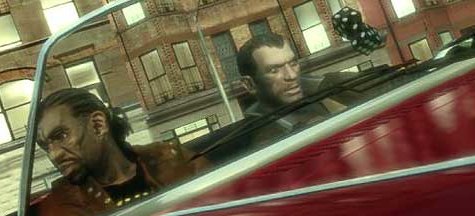
It only seemed appropriate to post an update to my tale of morality in Liberty City, given that Jeff is now dead. It’s also appropriate, this time around, to talk slightly less in the first person.
Once again, the player bumps into Jeff on the street – a small blue icon on the map. Niko bumps into him; he’s staring through a pair of binoculars at a house across the road. Niko is really unenthusiastic about meeting Jeff again, which I was pleased about. One trend that emerges throughout GTAIV is that whilst Niko has no hesitation about doing dirty work, that’s all very dependent on the reasons behind it. He’s angry that Brucie made him kill people simply because Brucie was hopped up on steroids, for instance; he’s less angry about crimes that fit within his moral spectrum.
Niko is really angry with Jeff. This made me feel somewhat relieved, if only because it felt like this was going to pan out a bit better. It turns out that Jeff has remarried (an instance of GTA’s somewhat liquid attitude to time) and is sitting watching his wife meet her ex. Of course, he’s decided this is a bad thing, and he wants Niko to kill her.
Niko’s having none of it, and gets quite angry with Jeff. Jeff starts yelling; Niko is “just like all the others“, it seems, and Jeff crosses the road to do the deed himself.
At this point, I’m thinking: is this where I get to kill Jeff, right? This is where Niko gets to demonstrate a wider spectrum of his morals.
And then a supercar piles down the street and runs Jeff over. He bumps over the windscreen, scattering the contents of his wallets, and lies splayed on the pavement. A lawyer-type leaps out of the car, gets on the phone, starts telling the police he’s had an accident. Jeff is still, splayed in the road.
Jeff has been killed in an accident appears, as a legend at the bottom of the screen.
I’m glad; I’m disappointed; I’m chastised. I’m glad he’s dead. I’m disappointed I didn’t get to kill him. I’m chastised for thinking about murdering a civilian.
The Jeff arc is a tiny, optional, three-mission plot in GTAIV, and I’m sure many players won’t experience it. I’m not sure it does much for the game’s misogynist reputation, which is something I am still sitting on the fence about – I have issues with some of its characterisation, for sure, but am not convinced of all the criticism thrown at the game. At the same time, it addresses an interesting issue that hasn’t really come up in the series (even in San Andreas, where it might have been an obvious fit): namely, the gap between criminals and civilians, and also more objective viewpoints of “good” and “bad”. The game is so heavily based upon subjective morals that it’s a really interesting shift of perspective.
Whilst the Jeff missions were presented as a real arc, rather than a series of disparate events, I’m still totally frustrated by the lack of freedom offered in the second Jeff mission, which was really quite unpleasant and made me genuinely angry. Still, I’m glad I played through to the end of the arc. For what it’s worth, there was a sense of closure.