-
"Prototypes for Mac turns your flat mockup images into tappable and sharable prototypes that run on iPhone or iPod touch." Nice.
-
"My dream cloud interface is not about booting virtual machines and monitoring jobs, but about spending money so my job finishes quicker. The cloud should let me launch some code, and get it chugging along in the background. Then later, I would like to spend a certain amount of money, and let reverse auction magic decide how much more CPU & RAM that money buys. This should feel like bidding for AdWords on Google. So where I might use the Unix command “nice” to prioritize a job, I could call “expensiveNice” on a PID to get that job more CPU or RAM. Virtual machines are hip this week, but applications & jobs are still the more natural way to think about computing tasks." Yes, this. And: lots of people _think_ the cloud works like this, but it really doesn't, yet. Parallelization/adding computing power is more practical, but it's not been made easy like a bunch of other things have (so far).
-
"I have this colleague of mine who is an avid rock climber, and I’m trying to get him to play GIRP. He says that what I’m saying is like, “I’ve come up with this new formula of crack that’s ultra-addictive; why don’t you try this new crack I’ve cooked up?”" Wait, Bennett GIRP/QWOP Foddy was in *Cut Copy*?! Awesome.
-
"…another Monorail Society Exclusive!" The decision, you might have guessed, is turning down a monorail. Does sound great, though, and easy material for writing alternate-pasts.
-
"Unlike the movies that influence it, LA Noire takes place in a world where editing hasn't been invented yet." Really good writing from Tom Chick; this was perhaps my favourite quotation. I genuinely wonder how many people playing this game have never played a "proper" adventure game – be it an old Sierra point-and-click, or something from the Phoenix Wright/Hotel Dusk school. Chick's line about the matchbook is exactly the thing adventure gamers got fed up with in the *late nineteen-eighties*. We don't need the bad parts of Sierra coming back to haunt is.
-
" I think Zemeckis and Gale knew all the timely accoutrements signifying "the present" in Back To The Future would inevitably look like 1985 within just a couple of years; in fact, they were banking on it. Zemeckis and Gale were trying to create an archetypical representation of 1985 just like they did for 1955, with its soda fountains, social repression, and subjugated black people. In this way, Back To The Future only gets better the further we get from the '80s. Everything that defines Marty McFly—how he walks, talks, acts, and dresses—acts as instantly recognizable shorthand for the year he comes from." This is great.
-
"Let’s own the work that goes live, understand and explain why it is as it is, and work on the skills we need to make sure more good design actually makes it over the line. Otherwise, what’s the point?" Yes.
-
"Unsurprisingly, having recognizable cartoon characters on the boxes caused kids to rate a cereal as better tasting, affecting their subjective assessment of it."
-
This is working well for me: rapid calendar input, not too big on the menu bar, and yet nice support for multiple calendars and the like. Pretty much meets my calendar-input requirements, and leaves iCal to do the heavy lifting.
-
"Johann Sebastian Joust! is a no-graphics wiimote dueling game prototype for 3+ players. We developed it at the Nordic Game Jam 2011." Fun: electronically-enabled, no-screen gaming, which in this case is primarily about putting other players off and interfering with their controls.
-
Gosh, what a lot of topics: fashion, fabrics, architecture, space, cybernetics, cities, all spinning out of the development of the spacesuit. Cracking interview, impossible to pick a quotation from.
Waving at the Machines
21 May 2011
There was a line in this blogpost about what it’s like to QA Kinect games that really caught my eye.
The cameras themselves are also fidgety little bastards. You need enough room for them to work, and if another person walks in front of it, the camera could stop tracking the player. We had to move to a large, specially-built office with lots of open space to accommodate for the cameras, and these days I find myself unconsciously walking behind rather than in front of people so as not to obstruct some invisible field of view.
(my emphasis).
It sounds strange when you first read it: behavioural change to accommodate the invisible gaze of the machines, just in case there’s an invisible depth-camera you’re obstructing. And at the same time: the literacy to understand that there when a screen is in front of a person, there might also be an optical relationship connecting the two – and to break it would be rude.
The Sensor-Vernacular isn’t, I don’t think, just about the aesthetic of the “robot-readable world“; it’s also about the behaviours it inspires and leads to.
How does a robot-readable world change human behaviour?
It makes us dance around people, in case they’re engaged in a relationship with a depth-camera, for starters.
Look at all the other gestures and outwards statements that the sensor-vernacular has already lead to: numberplates in daft (and illegal) faces to confuse speed cameras; the growing understanding of RFID in the way we touch in and out of Oyster readers – wallets wafted above, handbags delicately dropped onto the reader; the politely averted gaze whilst we “check in” to the bar we’re in.
Where next for such behavioural shifts? How long before, rather than waving, or shaking hands, we greet each other with a calibration pose:
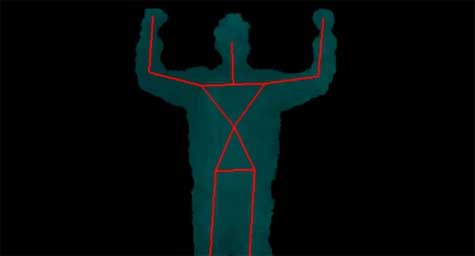
Which may sound absurd, but consider a business meeting of the future:
I go to your office to meet you. I enter the boardroom, great you with the T-shaped pose: as well as saying hello to you, I’m saying hello to the various depth-cameras on the ceiling that’ll track me in 3D space. That lets me control my Powerpoint 2014 presentation on your computer/projector with motion and gesture controls. It probably also lets one of your corporate psychologists watch my body language as we discuss deals, watching for nerves, tension. It might also take a 3D recording of me to play back to colleagues unable to make the meeting. Your calibration pose isn’t strictly necessary for the machine – you’ve probably identified yourself to it before I arrive – so it just serves as formal politeness for me.
Why shouldn’t we wave at the machines? Some of the machines we’ll be waving at won’t really be machines – that telepresence robot may be mechanical, but it represents a colleague, a friend, a lover overseas. Of course you’d wave at it, smile at it, pat it as you leave the room.
If the robot-read world becomes part of the vernacular, then it’s going to affect behaviours and norms, as well as more visual components of aesthetics. That single line in the Kinect QA tester’s blogpost made me realise: it’s already arriving.
-
"Get great articles delivered to your Kindle without any extra effort." Curated content, delivered direct to your Kindle via the email interface. Will try this for a bit: it's a really obvious opening in the space, and scope for there to be many of these.
-
If you're going to write a review for a digital medium about a recursive game, this is as good a way as any to do it. Bravo.
-
"You wouldn’t think you could get homesick for a simple button. You’d be wrong."
-
A lovely piece from Dan on Meek's Cutoff and Oregon Trail.
-
"My daughter was first sued in the womb. It was all very new then. I'd posted ultrasound scans online for friends and family. I didn't know the scans had steganographic thumbprints. A giant electronics company that made ultrasound machines acquired a speculative law firm for many tens of millions of dollars. The new legal division cut a deal with all five Big Socials to dig out contact information for anyone who'd posted pictures of their babies in-utero. It turns out the ultrasounds had no clear rights story; I didn't actually own mine. It sounds stupid now but we didn't know. The first backsuits named millions of people, and the Big Socials just caved, ripped up their privacy policies in exchange for a cut. So five months after I posted the ultrasounds, one month before my daughter was born, we received a letter (back then a paper letter) naming myself, my wife, and one or more unidentified fetal defendants in a suit. We faced, I learned, unspecified penalties for copyright violation and theft of trade secrets, and risked, it was implied, that my daughter would be born bankrupt." This is marvellous