-
"The CYPD4225 is definitely not rated for space. I have no idea if it would work in space."
This is fun, but also detailed. USB-PD chargers need a microcontroller to do power negotiation. So how powerful is a USB-C PD charger compared to, say, the Apollo 11 guidance computer? Forrest Heller goes into some detail – not just comparing clock speed, but also looking at memory, and clock-cycles per operation.
-
"Here is, instead, the first reading that occurred to me, looking at these reimagined vistas set among the tall columns of RIBA headquarters: the idea that videogame architecture is essentially a folly, something that takes the form of a building that has a physical function, but which cannot meaningfully fulfil that function and which instead uses its simulated practicality to fulfil, say, an emotional or aesthetic or wayfinding purpose. I read Playing the Picturesque as suggesting that we might use the existing centuries of design and discussion around follies, and the long related history of arguments about the “picturesque”, to usefully inform the ways that we look at videogame architecture."
Lovely writing – dense, detailed, and shrewd – from Holly about a show I must go and check out.
-
"I view ValhallaPlate as being closely related to an SM57. Or a hammer. No need to be delicate with the tool. No need to think about things too much. It just works." I liked this line on toolmaking, especially when it comes to music technology.
-
Much more Illustrator-like than Sketch is, in many ways, and affordable. Certainly leaps ahead of Inkscape in not being rubbish. Going to use this for lasercutting/frontpanel work, I think.
-
Really good article on the realities of installing iBeacons, and, secondarily, the way you develop your own internal processes just to solve workflow. I liked the trolly; I felt for the BKM very much as I read this.
-
Translating Gender: Ancillary Justice in Five Languages Alex Dally MacFarlane | Interfictions OnlineFascinating article capturing how various translators worked around their languages to translate not only the absence of gendered language _suggested_ in Ancillary Justice, but also the author's deliberate use of the feminine as a generic case. (Also, how to translate things for different cultures – what they expect and what they intimate).
-
Yes, it's a bit heavily focused on copying/emulation, but there's some useful stuff in here and some interesting starting points.
-
Thoughtbot's engine for Rails admin UIs, sans-DSLs. Filed away for reference.
-
Corrie Corfield on Peter Donaldson. Lovely.
-
[this is good] and I will remember more of it in future.
-
Wonderful, dense, three-part study of one of GTA V's renderer. I like Adrian's posts because he focuses on the art of the technology, as well as the technology of the art; a reminder that game art isn't just plonking OBJ files into a world, but relies on a whole host of developers, maths, and drawcalls.
-
Interesting; the wrapper Github used for Atom, as a platform. Makes building desktop applications for web-folk like me a notch easier, though as ever, I find the Javascript ecosystem baffling.
-
Wonderful article from an architect who worked on "The Witness" about the role of architecture practice in game design, and all the rough edges architects see within game worlds. Good on spatial design principles, too.
-
"Every gallery project needs an Andy" – and other insights from Tim Hunkin on installation design, following his work on 'The Secret Life of the Home' at the Science Museum. All rings very true for me, and glad to see it's not just me that finds this sort of stuff challenging. Also: very interesting on museum culture.
-
Lovely interview between Jeff Bridges and Roger Deakins – on film, and how they get made, and feel. Lots of deep knowledge and affection in this; I really enjoyed it.
-
"Bear in Space has an unusual premise for a children's book. It is the fictional story of a bear who shares film of his vacation to the Moon with his animal friends, but that is not the unusual part." Bear faked his trip; his photographs are clearly manipulated. The child should pick up on that, but will Bear's friends? A Russian tale of space travel from 1970.
ghostcar
30 July 2012

There’s a copy of me running around London. It runs at the right speed, but it’s unstuck in time: unstuck by 365 days, in fact.
Tom Armitage In The Past is a foursquare user. He checks in where I was a year ago. He says what I said a year ago. As long as the game systems haven’t changed, he gets the badges I got a year ago. (And, if the game rules do change, he’ll start to deviate from me).
He’s maintained by a piece of software I wrote called ghostcar.
In racing games like Ridge Racer, your previous time attack high score is often represented by a 3D outline of a car rendered into the same world as you – a “ghost car”. Matt Jones reminded me of this at the pub one night, as I explained my idea, and the project had a name.
It’s not a spambot. I’m its only friend; it’s invisible to people who aren’t its friend. It’s invisible to venue owners – ie, it’s not generating false marketing data. Honesty is Foursquare’s main currency: saying where you really are, being who you really say.
I’m not breaking the terms of service. When I wrote it, the Foursquare terms of service told me I couldn’t impersonate other people.
But I’m not impersonating other people. I’m impersonating myself. That’s got to be OK, right?
So: why did I do this?
There were two main inspirations. Firstly, James Wheare’s Twitshift (now sadly closed). Twitshift works because its output is in the same medium as the source data. I didn’t warm to Timehop because it was just an email. Email is good, and there’s value in juxtaposition – but anyone can send an email. Email dilutes the notion of “being”, however. Foursquare is not, precisely, about presence – it’s just about saying you were somewhere – but email about foursquare feels like another abstraction layer. I wanted to minimise abstraction. And so, to do that, I’d need to build a Foursquare timeshifted-echo service that itself output to Foursquare.
Secondly, I remember Kevin Slavin talking about Area/Code’s wide, GPS-enabled game Crossroads at dConstruct a few years back – and how, once, when testing, it the game’s entirely digital antagonist “Papa Bones” moved through their office, and every GPS-enabled phone they were testing the game on suddenly jumped. What made the virtual “ghost” interesting was when it manifested in the world. Even though it wasn’t real – and everybody knew it wasn’t real – it still made you jump when you were there; the juxtaposition of knowing something is right where you are, even if it isn’t a real thing, is highly striking. I wanted to explore that a little with my own data.
I don’t check up on Mr Armitage In The Past very much. The idea, rather, is that I might bump into him some time. How strange: to be in one of my usual haunts, and know that a ghost of me, a year in the past, is also there, watching a movie, having a drink. Sometimes, those memories are less cheery than others. Sometimes, they’re brilliant. It gives me a visceral memory: reminds my bones, my heart, what they felt. (That, for reference, is my defence against nostalgia. This isn’t just about nostalgia, because you might not like what it makes you feel. It’s just about remembering feelings; stopping to pause and remember the passage of time).
It’s also made me check in to Foursquare a bit more. The moment I fired ghostcar up, I realised I needed to start giving it better data so that it’d continue to have meaning a year in the future. So that’s a strange, interesting takeaway: changing my behaviour because I want the fossil record to be more accurate.
I was only going to find out what it felt like by making it, so I made it. It chugs away on my server in private. I run ghostcars for a few friends, too. It’s not particularly elegant, and I don’t think it’d scale to loads of users, so for now, it’s a private distraction. But I thought I should write it up. If you’d like to run your own install, the code is on Github. It’s a minimally documented Rails app, because it was made just for me, but you might enjoy it.
In the meantime: I go about my business, and an echo of me in the past will do one day, too.
-
"So, given this [zero-button, move and look] interface, whence interactivity in Dear Esther? I say: from an understated but deadly-precise sense of attention design through spatial design.
You walk along the beach; a path goes up the bluff, another along the strand. You go one way or the other. There are no game-mechanics associated with the choice, and a plot-diagram analysis would call them "the same place" — you can try either, back up, and go the other way. But this misses the point. Precisely because the game lacks keys, switches, stars, and 1ups, it has no implicit mandate to explore every inch of territory. Instead, you want to move forward. Backtracking is dull. Worse: given the game's sedate walking pace, it's slightly frustrating. (They left out the run button for a reason, see?) Moving into new territory is always the best-rewarded move, and therefore your choice of path is a choice. You will not (unless you thrash hard against the game's intentions) see everything in your first run-through." Cracking writing about immersive, environmental storytelling in Dear Esther, and why it's clearly a game.
-
"…he still remembers his frustration at encountering "sliced-up ghettos of thought" – sculpture, architecture, fashion, embroidery, metalwork, product and furniture design all in separate departments – "which I don't believe are absolute. It's just the way we categorise things and the way we chose to educate people."" Quite excited to see the Heatherwick show.
-
"Super-simple baseline .mobi templates. Here ya go."
-
It's basically a satellite that's an external Android peripheral, and they're chucking it into space with a phone attached. Impressive.
-
Interesting list; worth spending some time staring at, for sure.
-
"This December, in a surprisingly simple yet ridiculously amazing installation for the Gallery of Modern Art in Brisbane, artist Yayoi Kusama constructed a large domestic environment, painting every wall, chair, table, piano, and household decoration a brilliant white, effectively serving as a giant white canvas. Over the course of two weeks, the museum’s smallest visitors were given thousands upon thousands of colored dot stickers and were invited to collaborate in the transformation of the space, turning the house into a vibrantly mottled explosion of color." Lovely. I really like Kusama.
-
"I am not naive and I am not a fool. I realize that gamification is the easy answer for deploying a perversion of games as a mod marketing miracle. I realize that using games earnestly would mean changing the very operation of most businesses. For those whose goal is to clock out at 5pm having matched the strategy and performance of your competitors, I understand that mediocrity's lips are seductive because they are willing. For the rest, those of you who would consider that games can offer something different and greater than an affirmation of existing corporate practices, the business world has another name for you: they call you "leaders."" Ian's whole article is great, and the comment thread is eye-opening.
-
"Something terrible has happened in our city (and may yet continue to happen). It's damnable, deplorable, heartbreaking. But it is also extraordinary, unusual, bizarre. Slamming the door on it without studying and understanding it is a dangerous and short-term tactic. Allowing yourself to feel nothing but anger, and doing nothing but lashing out … isn't that a little mindless? It would be nice, and useful, if we could ask London "why" without already having an answer in mind." Excellent, sober, cautious writing from Will Wiles.
-
"In this volume, people of diverse backgrounds — tabletop game designers, digital game designers, and game studies academics — talk about tabletop games, game culture, and the intersection of games with learning, theater, and other forms. Some have chosen to write about their design process, others about games they admire, others about the culture of tabletop games and their fans. The results are various and individual, but all cast some light on what is a multivarious and fascinating set of game styles."
-
Lovely little round-up of games about architecture and the urban environment from Kars.
Walled Gardens and the Instrumented City
24 June 2011
Cities are full of public space; between the buildings – most of which are private, some of which are public – is space, most of which is public, some of which is private.
Some of that public space isn’t, really. It looks like it is – and part of the conditions of its existence are that it serves as a limited thoroughfare – but it’s very much a private space that you’re lucky to be allowed on, and which can be policed privately.
Nowhere is that more obvious than More London – a complex directly west of Tower Bridge, where City Hall resides, as does a variety of office buildings. It contains the obvious walking route along the river front; it’s designed as a very public space. But it isn’t at all: it’s private property, with its own rules.
Lock a bike to a lamp-post and this happens:

That lamp-post wasn’t yours to lock it to. This sort of thing both frustrating and confusing: why does this space, which looks like any other space, behave differently? How was one to know it wasn’t, technically, public? If you don’t see the little signs, you wouldn’t know. People walking freely, people eating their lunch in the open spaces: these are much greater signifiers for the urban citizen, and these all seem to fit a representation of “publicness”.
More and more of the city looks like this.
What happened with Tower Bridge on Twitter a few weeks back was a reminder that this is also true online. Twitter isn’t a public space like the domain name system is; it’s a private one, and you’re at the whim of its Terms of Service. I infringed its Terms (just), things got moved around.
So far, so walled-garden. We’ve seen things like this before.
But there’s a slightly larger, and more complex question raised here, and that’s the one I’m much more concerned about.
The frustrations that you see in the real city are coming to the instrumented city, and this highlights an interesting set of problems if you’re designing that instrumented city.
(What follows is not about my bot in specific; it’s about the state of existing terms of service around the web, and what they mean for any form of instrumentation and augmentation).
The idea that an object representing a structure itself in the first person isn’t allowed to describe itself is problematic; the idea that someone with the rights to a trademark has more claim to represent a structure, an edifice, than a stream of information that the structure itself produces is… troubling. (I’m not sure I can find the right word there just yet).
There’s something important about authorship and identity here, and the idea to suggest that the streams of information about a structure come from anywhere other than that structure itself feels backward.
(I would, of course have no problem if the trademark owner wished to produce that stream of information themselves).
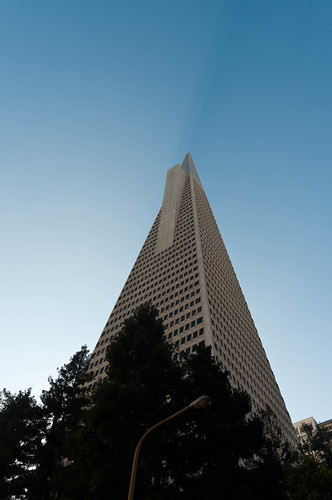
The Transamerica Pyramid doesn’t have an account on Flickr so that people can pretend to be it, or pretend to upload photographs in its name. It has an account so that it can be pointed at in other photographs; it has an account so that it can be referenced just like a person. How do you enable something to serve that purpose if it doesn’t have the actual name of the building in question? The account isn’t impersonating the building; it is the building. Those photographs aren’t lying about having the Pyramid in them. (As it stands: the account on Flickr is called “The Pointy Building”, which is both non-infringing, but also a more accurate representation of what most people call the building anyway).
There are obvious issues that the Instrumented City, ultimately, will find ways around. Twitter – a short, written-language service – really isn’t the best format for instrumenting the city in the long run; it’s just what some of us are using for now. So I’m not worried about service-specific issues or any particular terms of service. I’m sure that the city of data will find more detailed, specified delivery formats for its information that building-owners will buy into, although I’d hope there’d still be an emphasis on the human-readability of such information.
For now, though, this is what we have, and these are the issues we have to work around, and they bear thinking about.
-
Gosh, what a lot of topics: fashion, fabrics, architecture, space, cybernetics, cities, all spinning out of the development of the spacesuit. Cracking interview, impossible to pick a quotation from.