-
"We create physical, social games for public space. Our games get people moving and talking. They stimulate their creativity and get them to connect." Kars has a name for his new venture.
-
"The interesting, or arguably uninteresting, thing about this programme is that it is completely lacking in any sort of narrative arc. All the other programmes on Saturday night are a gift for a narratologist: with their judges’ scores, audience votes and dance-offs/sing-offs, they are all crisis, crescendo and narrative resolution. But Hole in the Wall is different. It’s just celebrities going through these differently-shaped holes in the wall, again and again and again… Hole in the Wall is the groundhog day of Saturday evening light entertainment." Saturday-night audiences like a good plot.
-
"And that is the best definition of casual that I can come up with: Casual players cannot be rated better or worse than other players." Torres finds a nice overlap with the Hicks/Hudson duality; I like his suggestion that casual players don't have metrics for comparison, because their primary goal is fun, and you cannot compare types of fun.
-
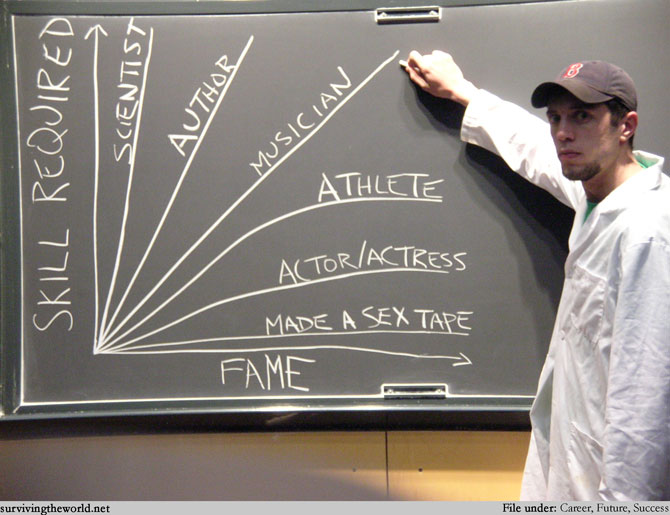
"File under Career, Future, Success"
-
"An obsessive meeting schedule is an investment in the boring, but by defining a specific place for the boring to exist, you’re allowing every other moment to have creative potential. You’re encouraging the random and random is how you’re going to win. Random is how you’re going to discover a path through a problem that one else has found and that starts with breathing deeply." Oh. That's an interesting way of looking at it.
-
Alan Taylor on a year of the Big Picture. It's been a successful one, if you ask me, and it's a wonderful site; there are few updates in my RSS reader I look forward to as much as it.
-
If you want a wrap-up of the Microsoft keynote, you could do no better than Brandon's wrap-up for Offworld – spot on, nicely detailed, and covering all the facts with great illustration. Whilst their titles – L4D2, Forza 3, etc – are obviously real assets, it's their commitment to the 360 as a platform in the living room that was impressive.
-
"The reason for [Singstar's relatively "low" Metacritic scores] is also the reason that this is an article about SingStar, and not a review of SingStar Queen and the new wireless microphones: SingStar is now basically unreviewable. Unlike Guitar Hero: Metallica, or AC/DC Live: Rock Band, SingStar has morphed from a game into a service, and defies traditional critical judgement."
-
"I think issues of power and governance are going to swiftly rise in importance on internet communities, as they expand to include more different kinds of people. It's interesting that some of the best, most resonant ideas on these topics that I've encountered over the years has come from political writers and may have been produced even before the internet." Mike has read lots of books, and his quotations/sources here are great.
-
A wonderful old postmortem – on Shadows of the Empire for the N64. As a launch title, there was lots of working with unfinished hardware, prototype controllers, and SGI workstations; it's long and detailed, and a fantastic portal to a world that seems eons ago, even if it was only 12 years away.
-
"In fact the propeller is really rotating. Russians fix a magnet on their helicopter blades. The device sends a signal to synchronize a movie camera, allowing to visualize efforts and deformations on the blades." Hypnotic, and unnerving.
-
"Looking in, it’s clear that the game industry is broken and not getting fixed anytime soon. I will not be joining the game industry. I’m interested in building a profitable business making fun games in a good working environment, and that’s simply not what it does. Maybe I could hoist one more flag in the indie games parade, but I think of myself as building a Micro-ISV in the web software business. It’s a much nicer community." As usual: anyone with a degree of sanity looking in from the outside comes to the same conclusions.
-
"Usenet, IRC, forums, blogs, and now media like Twitter have all been black-marked as houses unfit for reason to dwell within. And so we roll our eyes, sigh, and quietly accept the idiocy, the opportunism, and the utter disrespect for our peers and ourselves that is technical discussion on the Internet. This need not be the case. It is possible to have a reasoned technical discussion on the Internet. People do it every day, particularly in smaller online communities where social norms are easier to enforce. We can do it."
-
Mike Kuniavsky being really good, again, about avatars, physical mashups, and mashups as opportunistic design. Loads of great stuff inside the pdf.
-
"…yes, if I’d gotten a Lenovo when you all suggested it, I’d have a spill-proof keyboard with drains. That’s my plan for the next time something horrible happens to my laptop, which should be any day now." Randall Munroe's laptop died. I blame the package management, rather than the milk, personally.
-
"They took the trailer from "WestSide Story" and made it look like "28 days Later", hillarity ensues." No, that's bloody brilliant.
-
"I would urge everyone to start looking at the world in a different way. Spend some time looking at everyday objects, at their design, their shape, their individual characteristics. Think ahead and imagine their significance. Many are interesting and aesthetically pleasing in their own right, if you just give them some attention." Martin Parr on noticing the everyday.
-
"The problem is that what made GoldenEye so good was a fleeting, transient quality that can never be grasped again: it's not that the game was especially brilliant by modern standards, but rather that it utterly eclipsed its contemporaries. These days, the FPS is as comfortable on consoles as it is on Windows, and for a Bond shooter to have the same impact as GoldenEye it would have to outperform Call of Duty 4, Halo 3, BioShock, and Half-Life 2. In short, it would have to be revolutionary." Although: a big part of what made it so good was the social side of the jerky split-screen multiplayer, and Live just isn't the same. Yes, there was the context, but there was also some kind of magical glue holding it all together. Still, there are lots of smart, sensible points here, about emerging from the shadow of Goldeneye.
-
"With Half-Life and Counter-Strike, and more recently Team Fortress 2, we've learned that we're no longer making stand-alone games but creating entertainment services. With Left 4 Dead we're extending that tradition by creating additional gameplay and releasing our internal tools to aspiring developers so they may also create and distribute new Left 4 Dead experiences." Lots of places have the news; this quotation is the killer, though. "Entertainment services". GAAS, anyone?
-
"What's So Great About The Wire?", a course at UC Berkley. Given the comparisons they suggest, to leave out any of Series 2 from their studies is, frankly, criminal.
-
"On Tuesday we shipped an update that added a bunch of features / bugfixes / balancing tweaks that came out of the community's feedback. In particular, it made some changes to the underlying TF damage system, and as part of that, it modified the way critical hits are determined. We thought it might be interesting to dig a little into the change, and hopefully give you some insight into our thinking." Another cracking example of explaining game mechanics clearly and directly, to an engaged community.
-
"You've got to get shit happening – you can talk about it, you can write it down, it means nothing until you actually make it and think f**k that's nothing like what I thought it was going to be! That happens most of the time." Gary Penn on prototyping, getting real, and how they do stuff at Denki. More good stuff.
-
"We always start with the idea of toys," says Ralfe. "They're the quickest way into finding fun. Rules aren't fun, so we never begin with them." Great feature from Keith Stuart on a visit to Denki; lots of good stuff in here.
-
"The point here, is that the flickr team did not wake up one morning and think: “You know, if we captured THIS kind of data, we could create this mashup; so let’s create an application.” Instead, they re-used data they were already capturing, and brought out something very interesting indeed. By creating tools which match their data (and could be used with other data of the same kinds), flickr is able to expose layers of value from the rich-pickings of their own data-cloud. The good stuff is where the data are." Yes, it is.
-
"Some people love this kind of aggregation. Good for them. I, however, am human and my eyes glaze over when trying to comprehend a chronological stream of equally-weighted events, a format only robots could love. This is rubbish… There must be better ways of showing such “here’s what I’m up to” information." Phil talks about some problems he's been trying to solve with dashboard displays.
-
"A magnificent, huge orca-like beast, swimming calmly through the vast ocean beneath my smoke-belching craft. She was a beauty. And she instantly became my Moby Dick. “I’m coming back for you”, I thought. Big Shirl is a reason to reach level 80. I have no doubt the grind will get to me before too long, or that the thought of repeatedly running the same dungeons or battlegrounds come level 80 will turn me off all over again… In these early days though, before everyone in it knows everything, it’s an explorer’s paradise. That’s why I play MMOs." A nice, thoughtful article from a first look at WotLK from Alec Meer
-
"Wow. Ever get the feeling you've been thrown for a loop? I did just that, when I worked out that GSW commenter and erudite game blogger, PixelVixen707, appears to be not just a smart game blogger, but a fictitious front for some kind of damn weird ARG/online story." Down the rabbit hole we go, again.
-
"SourceForge is about projects. GitHub is about people… This is a pivot of the traditional open source project website. A pivot from project to programmer. I love the pivot."
-
"At the start it seemed reasonable to think that Mirror's Edge could stand entirely on the merits of its brilliant core concept, and not need to include extraneous and negligibly attractive features to appeal to as many people as possible. But, no, this is the video game business." This is the stuff that's scaring me most about Mirror's Edge.
-
"…in recent years, [the stage has] moved away from those practices. Today, we better understand the importance of offering kids the very best we can do. They are no different from the rest of us. They respond positively to quality, and they quickly grow bored and restless with mediocrity… We might consider a similar approach to video games. If we want our kids – heck, if we want all of us – to enjoy quality games, we must pay attention to and promote those games that deliver quality."
-
From Duncan Harris; postcards from post-apocalyptic DC.
-
Course notes from Stanford's Cocoa programming course.
-
"As the population of the system grows, everyone's personal horizons begin to shrink. With enough people, eventually you're talking to the people right in your neighborhood. To get a message to someone across the country, you might lie about your location, or ask that it be passed on, Milgram-style." Filtering by proximity in a restrictive – but potentially more useful – manner. Interesting.
-
"This is the challenge, it seems to me: it's to do with the tools of design– rules and states– what other media do with images and sound: reveal the world as seen through different eyes, with lapidary clarity and moral courage. And this means moving beyond merely empowering and entertaining the player."
-
"Everything breaks, so what happens when we wire the world on the sort of massive scale being proposed and every day is more irritating than the next? Probably what will happen is that people will just walk away from the entire project damning it first with market insignificance and if that doesn't work then rendering it meaningless with government regulation. It's worth at least talking about." Aaron is awesome.
-
"Introduced by Dr John C.Taylor, Invenit et Fecit" – or, to translate, he invented it, and he built it. Video explaining some of the finer points of the chronophage. Stunningly beautiful.
-
"He calls the new version of the escapement a 'Chronophage' (time-eater) – "a fearsome beast which drives the clock, literally "eating away time". It is the largest Grasshopper escapement of any clock in the world." Stunning new timepiece for the Corpus library. Breathtakingly beautiful.
-
"Computer Entertainment Thirty-Five Years From Today: A solo spoken word performance by Bruce Sterling" Wonderful, surreal, exciting; Sterling's keynote from Austin GDC. Good stuff, and worth a read for gamers, futurists, and designers alike.
-
"This is something I said about Spore a while back, actually. I thought Spore could be a little like what Understanding Comics is to Comics. As in something from the form which uses the form to explain the form." Oh, I like that as an idea. He can be a smart one at times, that Gillen.
-
"I've just finished attending the AIR tour and during the final (particularly funny) presentation, I completed a TextMate plugin that has full API completion support." Useful – some syntax completion, and a shortcut for application preview.
-
"We hijack innocent tweets, subject them to our patent pending penisization process by replacing certain words with 'penis', and republish it for your entertainment. We find it funny."
-
"I was at Aperture Foundation a Tuesday to see a panel about collecting photography, and I haven't been able to get this image out of my mind since." Oh wow.
-
"You might argue that an iPhone without connectivity is, well, an iPod, but its not. To state the (obviously overlooked) obvious – it is a phone without connectivity and that over time the ease and evolving practice of disconnecting fundamentally changes our assumptions of what we can expect from a phone, which in turn alters our expectations about the connectivity of other people." Jan Chipchase on pause buttons and understandings of what "social" means. Excellent.
-
"…then, after destroying his nano-network, as an admonition to the audience, extended [Arthur C Clarke's metaphor]: 'Any truly advanced technology is indistinguishable from garbage.'" Excellent summary of what sounds like a wonderful GDC Austin keynote from Bruce Sterling.
-
"'What we've done in MMOs and what we tend to lean toward is building an enviroment for the new player to explore that is essentially a safe environment… the newbie zone. For our explorative learners, we've given them safe zones to explore.' But that doesn't work for imitative learners." Excellent article on styles of learning, with particular attention to how MMOs teach players game mechanics.
-
"Very recently an anonymous poster on /b/ claimed to have hacked Sarah Palin's Yahoo e-mail account." 4chan members get into Sarah Palin's barely-disguised Yahoo mail accounts which she used for business.
-
Oh boy.
-
“I decided to create Flatshare fridge because there is nothing more disgusting than a dirty fridge in a shared flat,” he says. “At the time, I was living in such a flat!” Amazing.
-
"It occurred to me that if I could somehow tether a DSLR to an instant-on device like an Arduino microcontroller I would have less weight to carry around and could get more work done. After mentally spec’ing out what I would need, I realized the solution was right in front of me – because I bring it with me for Mario Kart wireless races on long night jobs – (In the manner of John Lasseter’s slow epiphany voice): “Use-the-Nintendo-D-S.” Duh." Oh wow.
-
Soulja Boy reviews Braid. Oh dear. (Although: much as I want to mock it, he is correct that time-rewind mechanics are, usually, a lot of fun in and of themselves. But still.)
-
"I've just added a new feature to the site: maps showing many places at once. They allow you to, for example, see all the churches in London Pepys has mentioned in one glance. Or London streets, or places outside Britain, and more." Some fantastic maps-and-pins from Phil and Sam.
-
"The series "A New Taxonomy of Gamers" wrapped up last Friday. For your convenience, here are the links to all 11 parts in one convenient post." Oh, this looks good.
-
Heard some of this last night; a superb BBC documentary about Brian Wilson and some of his production techniques that shaped the Beach Boys' albums. Some great interviews, and lovely musical deconstruction of harmony and voicing. Obviously, as a "listen again" programme, it's only around for six days – so get listening!
-
"Hired as visual artist in the summer of 2006, my challenge was not only to clearly present Braid's mechanics and behaviors, but to help tell a story that was anything but literal: part anecdote, part artifice, part philosophy. This article explains the process of developing visuals for a nearly-complete game with a highly idiosyncratic identity, the challenges encountered, and some of the nuts-and-bolts of our methods and tools." David Hellman on his work on the art of Braid.
-
Man, SIGGRAPH papers have the best titles. This is a lot of seriously hardcore, cutting edge, graphic-programming nous. Also: "jiggly fluids".
-
"The negative side of this, as your experience illustrates, is that Braid just lacks any immediate sense of fun. It does not set out to entertain you, and with the exception of some pretty aesthetic moments it makes you earn the pleasure you take from it. (Portal, which makes for a good point of comparison, wants the player to like it and desires to be understood in a way that Braid does not.)" I think Pliskin is spot on, here
-
"An interesting article at Rock, Paper, Shotgun tackles BioWare's tackling of issues tackling modern society, tackling one of my Mass Effect plots in the process. I responded in the comments, and after looking at how much I yammered on, I figured it was worth posting here as a look inside how these things get into the game, and why some things that seem dumb get done." Patrick Weekes follows up the RPS post criticising his own plot elements with some frank self-criticism, and some interesting explanations; a reminder of how hard creating any kind of meaningful choice can be.
-
Yes.
-
A blog from Tom, Flora, and no doubt shortly et al, about life in Hackney.
-
Now this *is* interesting: a comments thread in which Michael Abbott's readers put questions to Iain Lobb, one of the designers behind Meta4orce… and he answers them candidly and informatively. Interesting stuff about the limitations of building games around TV shows for public service broadcasters.
-
"I thought it was a parking ticket, and was annoyed. But up close, I saw it was just an empty envelope someone put there…" I'll let you click through for the punchline. Delightful, nontheless.
-
Great selection of posts on how brands need to behave (and how they sometimes fail to do so) from Grant McCracken.
-
Narrative-driven flash game from BBC Switch. Combines animated cut-scenes with minigames representing key plot aspects; as such, it's very linear. Script by Peter Milligan, though! It looks expensive; I'd be interested to know how successful it's been. As it stands, it's a little bit Freakangels-lite, a little bit Torchwood. And yes, I know how that sounds.
-
A nice article about context, contracts, and a few other things related to game AI design. If you're interested in the field at all, it's a nice read.
-
"I believe that the “auteur” school of game development is not only outmoded, but dangerous to the vitality of the medium. Instead, we must pursue deeply collaborative work styles and seek out diverse teammates if indie game development is ever to reach new heights and thrive beyond its current audience." I need to come to a better understanding about auteurship in this field; I'm not entirely convinced by this article.