-
"Either your workplace is a family or it’s not. It’s not, of course. The very concept of the workplace as family is a tool for exploitation. But if it’s not, where does that leave us in relation to each other? What does it mean to care about your colleagues, to love them?"
Mandy Brown on defeating binaries, and on oddkin. Resonated strongly.
-
Cracking episode of EmbeddedFM, speaking to Amanda Wozniak. Although the topic is nominally embedded electronics, it turns into a wonderfully shrewd discussion of self-care and career-care: how to acknowledge and recognise your desires but also the things that will lead you to burnout (be it too much work, or too _intense_ work. I found so much to think on in this, highly recommended even if it's not your usual jam.
-
On the real life Firewatchers. Lovely.
Making a music box
04 December 2015
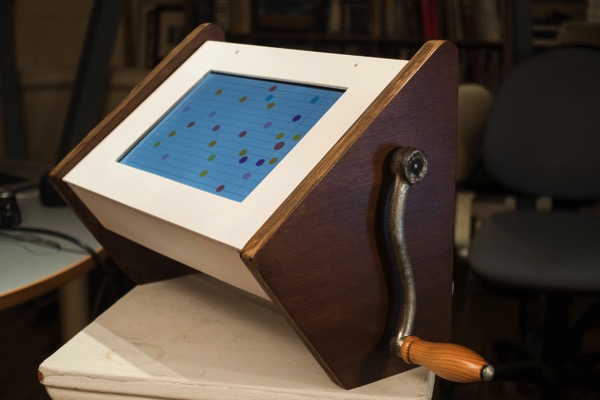
I don’t tend to blog work much over here – that’s kept on my professional site – but this is a good one:
I’m pleased to announce Richard Birkin and I have been selected as part of the mv.works 2015-2016 cohort. We’ve received funding to work until April 2016 on a new iteration of Twinklr – our physical/digital music box.
More at my site. Suffice to say: this is tickling lots of my interests (which you might have seen hinted at in the past year of links) – hardware; building tools for creation, building instruments for performance, improvisation, and composition; the interface of technology, music and sound. Quite excited.
-
I've read this post a few times, and it's still making me think. Lots of wisdom bound up in it, lots of things to aim for. Well done, Kellan.
Five things I’m thinking about: July 2015 edition
29 July 2015
Not written here for a while. That’s not deliberate; just been busy, keeping up with work, keeping up with life. Lots ticking away in my head, for sure. So, as a way back into keeping the ball in the air, I thought I’d take another pass at five things that are currently in my head (five years ago, that list looked like this).
Non-traditional (and irregular) ways of composing music
I’m working with Richard on building a music box. You know: holes in paper, a handle you crank, tines being struck. Although ours is electronic: there’s no paper, and no tines; you punch holes in virtual paper with your finger, and can easily remove them if you don’t like them. The handle’s very much real, though, and that leads to all manner of analogue compromises – lumpy rhythms, the ability to play melodies backwards, and so forth. I write about this in my Weeknotes from time to time.
It’s an interesting way of coming up with music, though: sometimes, it’s cranking the handle at the right speed – or right selection of speeds – that makes the music happen. Sometimes, it’s the notes you choose. Sometimes, you don’t even choose them: it’s just a picture you paint with your fingers. It’s an interesting UI for composition, and it leads to all manner of interesting irregularities.
It also can talk to other MIDI devices. As of the latest stable release, Chrome supports WebMIDI, which means it can talk to MIDI ports from inside the browser, just using Javascript. And that means our music box can control anything with a MIDI input, from a software synthesizer, to external hardware. And that’s exciting: the idea that the browser is a platform for experimenting with note-generation.
That leads to interesting sound experiments, but also things that aren’t musical: I’ve long been fascinated with the idea of using grids like the Launchpad as a UI, and now that’s all doable inside my browser. I keep wondering what a render() method within Backbone for a Launchpad would look like.
(I’ve also been thinking about this having seen my friend James’ work on a sequencer for modular synthesizers, and the way unusual UIs force you into different compositional habits. There’s so much beyond timelines and steps to explore!)
The music box – Twinklr – has inspired the next item on the list, too.
Making PCBs
I’m spending a while at the moment thinking about making PCBs.
I’m really bored of the slightly amateur stripboard I tend to make circuits from, so am hoping to manufacture the PCBs inside Twinklr myself. That means learning how to route PCBs from schematics or ideas in my head, for starters. I’m using Fritzing of all things – EAGLE makes me feel stupid – but am making progress on some PCBs that are getting passable elegant. I even have a ground fill:
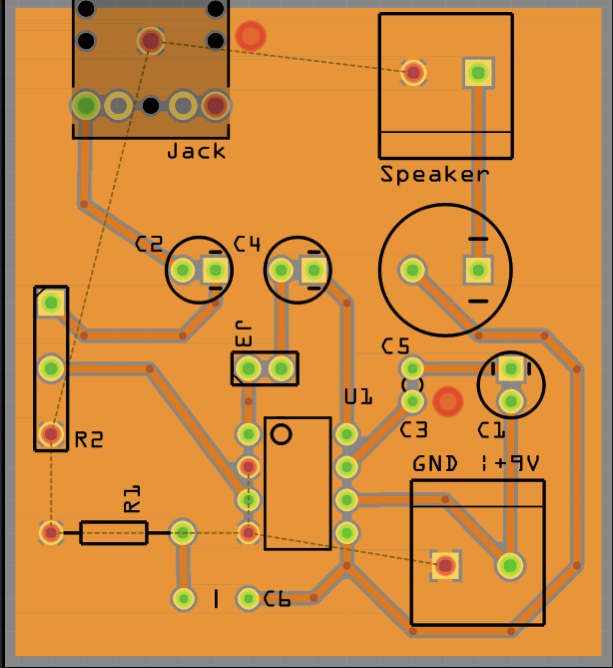
Of course, the next thing is manufacturing them, and I have all manner of tabs open with different recommendations on chemicals, techniques, and so forth. But it’s moving forward slowly, and I’m hoping that there won’t be any more unpleasant stripboards in future. Initial prototypes are suggesting that my homebrew PCBs might not be a go-er, and I might want to move to letting professionals manufacture them. But for now, I’m going to feel the materials with my own hands, and try not to get Ferric Chloride on anything.
Writing music
I’m slowly, carefully, returning to writing music again. I’ve produced music – largely electronic – since my late teens. Back then, it was on a variety of esoteric hardware. Now, it’s mainly inside computers, but with a growing tangle of instruments outside it.
I find this really hard.
What I find is: I will disappear into textures and sound design and harmonies and rhythms for hours on end, possibly just exploring the possibilities of a single sound… and by the time I ‘come up for air’, I hate everything I’ve done. Finding a way to compose with constant forward momentum, not looking back, not comparing myself to anything else I’ve heard… is so challenging.
It’s also rewarding: when I come back to something a day later and even if it’s not the best thing in the world, it’s a thing I’m happy to spend time with, a thing I have new ideas with. I hate the creative rollercoaster, and what I’m finally finding a way to do is to cling on and not let go. I still don’t like it, but I’d stopped riding it because I was afraid. And now I’m not. I’m working on finding ways to not repeat myself, not to fall into the same shaped holes, the same patterns and riffs. Which is also hard. But I’m turning up, at least.
I don’t mention the output, much. The Internet made our past-times and interests performative: sharing and showing-off are easy to confuse, and sometimes, I’m making sounds and music for myself. I’m so used to sharing things to all manner of services but, for the time being, it’s mainly just staying on my hard disk. It’s giving me pleasure; it’s time well spent. One day, I might share it.
Streaming, and its relationship to craft
I watch a surprising amount of Twitch: a service through which people stream themselves playing games. They’re not just sharing a screen; high-end streamers have chromakey rigs to insert themselves into the image, and manage large communities of people… who watch them playing videogames. It’s usually not nearly as interesting as it has the potential to be – although it’s great to tune into Evo live.
I know I said hobbies weren’t performative, but I’m fascinated by streaming things that aren’t games; streaming crafting, perhaps. (I greatly enjoyed BBC Four’s Handmande strand, three half-hour films of craftspeople at work as part of Four Goes Slow)
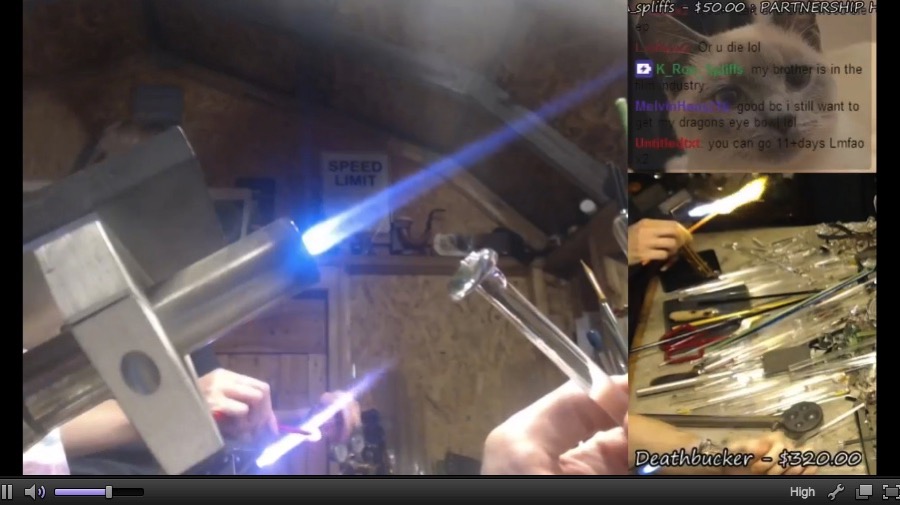
This chap does glassblowing on Twitch. I’ve watched a few people produce or compose music on camera. I watched a Counterstrike streamer get a hugely enthusiastic channel chatting whilst they watched him chilling out, putting together plastic model kits, one camera on his hands, the other as usual on his face:
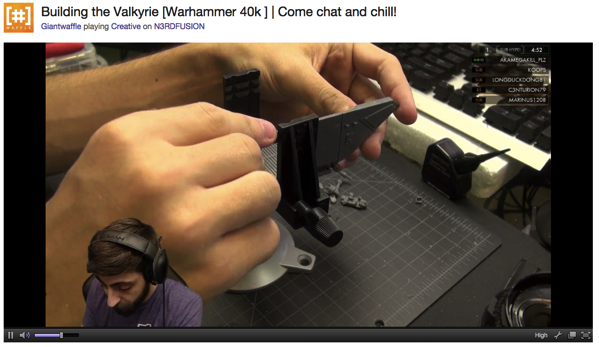
It works surprisingly well. Obviously, it’s very time-consuming for large projects, but consider how sharing works in analogue craft: the tradition of ‘stitch and bitch‘ is as much about injecting a social element into a potentially solitary craft as it is about sharing with others. Recently, I have often wondered what Stitch On Twitch would look like. Not watching someone make a whole quilt: an hour of tuning in to chat to them whilst you craft too.
Slightly unformed, but it’s floating around my head. Streaming isn’t particularly great, but I think it’s suited to things people aren’t broadcasting on it yet.
Windows of time: schedules rather than moments
I really like the Spotify Weekly Discover Playlist. I like it because, so far, it’s been really good at recommending things to me. But I also like it because it’s weekly. It’s not updated every time I go to it; I have time for those selections to bed in, to listen to it like a mixtape. And because it comes around once a week, it then generates anticipation – looking forward to my new mixtape from the Spotify machinery. It’s not manufactured scarcity; it’s not the fiddly, artificial limitations of so many dual-currency free to play games; it’s just schedule. It’s a fixed window of time, rather than a right-now moment.
I still regularly play Destiny (Bungie’s MMO-FPS hybrid) and one of its strong points is its weekly calendar. (Apologies for the brace of jargon incoming – I’ll do my best to explain). Every week, the universe resets: a new Strike (like a Dungeon in World of Warcraft) gets picked to be the ultra-challenging “Nightfall”; a new Strike is slotted into the weekly ‘heroic’ strike slot, for players not up to a Nightfall; new playmodes are rotated into PVP; sometimes, a new temporary event runs for the week. On a Friday, the Trials of Osiris – hardcore endgame PVP for the very few – start, and run over the weekend. On Friday morning, the mysterious vendor Xûr turns up for 48 hours, and everybody sighs as he doesn’t have the three things they want. And if you don’t finish it all by Monday night – well, it’ll reset at 10am GMT Tuesday anyway.
Sometimes, the schedule enforces scarcity – trying to finish the Iron Banner event before the week is out; sometimes, it enables planning – getting friends together to run a Nightfall at the beginning of the week, so as to benefit from the XP boost. Sometimes, it’s just a reason to check back in to the universe. And if there’s nothing that week to do for you – well, you don’t need to turn up. Maybe swing by in the future. It gives the game a long tail to players who enjoy it, without forcing them to check in to “top up”, like so many Free To Play games.
I like schedules because they’re actually surprisingly easy to fit into life: if they don’t fit into your schedule this week, it doesn’t matter, because it’ll all start again next week anyhow – you’ll get a new playlist; you’ll get a chance to run a different Nightfall. But at the same time: it’s not constant newness, all the time; the weekly schedule gives you a chance to stick your finger in the page for a period of time.
I am not sure what this will get applied to in my own practice, but it’s a thing at the back of my mind.
And that’s five. A bit malformed, but what’s floating around in my head for now. When I’m quiet, it’s usually because I’m busy.
-
"Show up for the work. For me, this means sitting at my loom every day and weaving for at least a few hours no matter what else might be pulling at me in business or in life. I was given this advice early on, in both my studio art education and in writing workshops I attended over the years. This commitment is the gateway to developing a habit, and in turn, a creative practice. The simple repetition of throwing the shuttle across the loom for even an hour has never failed to open up my thinking, ground my anxiety and, ultimately, move the work forward. Even if my thoughts don't dramatically shift, I can walk away from the work and see tangible evidence of a woven yard or two. Affirmation." As if I didn't need reminding. (I bookmarked this primarily, though, for the beautiful photos and workplace.)
-
"Once everyone got on-board with "anyone can make video games", then the weird leap in logic was, "who wouldn't want to make video games," and worse, "who wouldn't want to solely live off their video games?"" This is all lovely from Robert – especially noting that making art is not incompatible with, separately, working, and that creative endeavours do not have to be our sole life's work. (And: that doing things not full-time does not devalue them in the slightest!)
-
This isn't just 'good', 'nice read'; this is pretty vital. It all rings very true and reminds me of the best bits of the best places I worked. It's important for anywhere I work in future.
-
"At a coffee shop near his office, Kazemi says he feels about his bots the way he imagines parents must feel about their children. “I’ve created these things, and they’re kind of separate from me now, and so I do feel kind of proud of them,” he says. “Every morning I wake up and I look at the last two hours of TwoHeadlines, and it just gets me every time.”" Yup. That.
-
"Under the [Do What You Love] credo, labor that is done out of motives or needs other than love (which is, in fact, most labor) is not only demeaned but erased. As in Jobs’ Stanford speech, unlovable but socially necessary work is banished from the spectrum of consciousness altogether." This is astute and good, on what happens when work is divided into either "things you love anyway" or "labor that we will banish from view" – and the enabling forces that let someone Do What They Love.
-
"…we though it would be it would be interesting to ask the students to deconstruct a logic prevalent in the games industry (F2P) and to then apply that logic to a real-world system (in this case, a London transport) service." I loved this when Kars first told me about the brief, and I love seeing it again now.