-
Good notes on the value of interaction in data visualisation. I particularly like the emphasis on interaction as 'plussing', rather than a requirement.
-
Love this live demo of an Enigma Machine that follows the passage of each letter's encryption through the circuits of rotors, reflector and pegboard. It's a visual abstraction, but it makes it entirely clear what's going on, from key to lamp.
And: it's an Observable notebook, so it's editable and interactive! Ace.
-
I always love seeing debug screens from game developers – what they call things, how they conceptually model the work they're doing visually, and what metrics they track. Also, a reminder of the budgets for doing everything a modern game does. This post about Uncharted 4 is full of that sort of thing. Show everything!
-
"This site is based on the first section from Steve Reich’s 1967 piece Piano Phase. Two pianists repeat the same twelve note sequence, but one gradually speeds up. Here, the musical patterns are visualized by drawing two lines, one following each pianist." Lovely.
-
"Here we get a glimpse of an alternative figuration of data itself. Rather than some kind of precious (but immaterial) stuff, or fuel for market speculation, data here is a relationship, a link between one part of the world with another, and a trace that can be endlessly reshaped."
Week 10
21 December 2012
And that’s the end of 2012.
A very quiet end to the year: a few little meetings to wrap up one short project and investigate another. Otherwise, I treated it as roughly a half-week, and focused a bit on some personal work, none of which is really near completion.
On Monday, I also built the visualiser for this year’s Radio Roundabout. They wanted something “a bit New Aesthetic” for this year. I loosely interpreted this brief to produce a Kinect-powered visualisation of the studio.
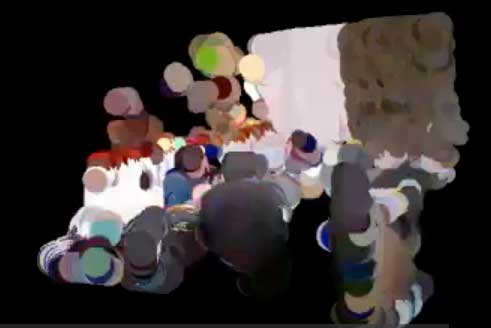
It’s very straightforward: it takes the IR point cloud in 3D, colours it according to what the video camera can see – and then applies a strokeweight to each point based upon the audio line-in level (RMS).
So what you get is a room full of blobs that pulse along with audio – particularly fine on the Dan Deacon or Todd Terje that played on the show, but fun with spoken-word too.
The whole project – all two hours of gluing other people’s code together – is on Github.
And that was it, really – a few leads on work I’ve followed up, but a quiet end to the year. Weeknotes are now on hold until 2013 – after the Radio 4 talk – and I’m hoping there’ll be a bit more news to share then.
Not a bad start to freelancing, then; here’s to 2013.
New Work: Spirits Melted Into Air
22 November 2012
I’m excited to be able to share Spirits Melted Into Air with you: a two-week exploration I produced with the Royal Shakespeare Company, as part of their myShakespeare project.
The work is in parts a technology prototype, data visualisation, and artwork. Custom-built, open-source software is used to analyse performance video and generate plots of actors’ positions on stage from a perspective viewpoint. These plots are then used to generate new, secondary artworks: posters, and laser-cut wooden shapes.
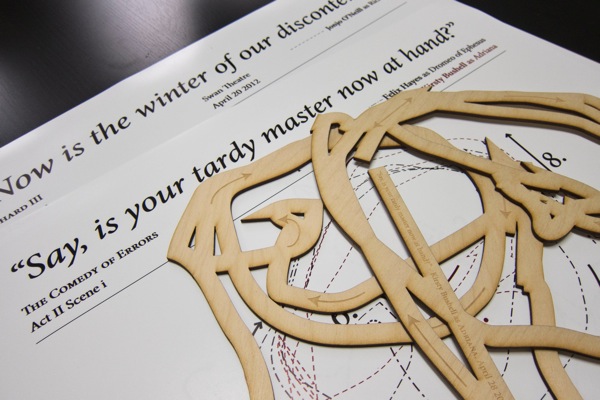
The project emerged from an initial workshop and commission by Caper, where we explored various potential ways for technologists to collaborate with the RSC on short projects. From there, I dealt with the RSC direct, meeting key members of their team and understanding a bit more about the various factors influencing performances and productions there.
It was great to be able to take such a fluid, interpretative approach to the work. With hindsight, this was unsurprising: the RSC’s business is interpretation – taking Shakespeare and producing entirely new productions each year, of plays they have often performed countless times. My work was similarly interpretative: initially, building software to explore the data, and then exploring that data as a material – before moving onto the further material exploration of output formats. It’s the sort of structure to work that I’m fond of.
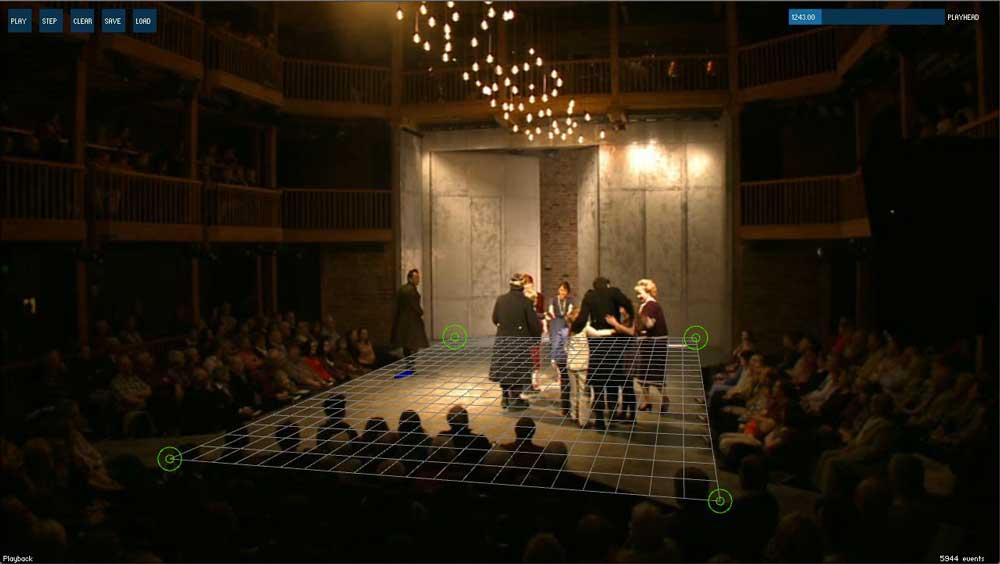
It was also great to have a brief to shape, and ultimately push myself: not just exploring a single technical idea, but seeing it through, end-to-end, to output and display. It was important to me that whatever came out of it – however prototype-y – was both beautiful and accessible. I think the output – especially the lasercuts – has stood up to that internal demand.
Thanks to Rachel and Kat at Caper for setting up the initial commission and the workshops; to Sarah and Ida, for producing the work from the RSC so superbly; and to everyone I met at the RSC who offered insight, ideas, and knowledge.
You can find out more at the Spirits Melted Into Air website.
And, if you’d like to know more about it, or indeed, to work with me on similar work – be it investigative, creative, or artistic – do get in touch.
-
A huge, fascinating, braindump from Bret Victor, mainly on the state of how programming is being taught (especially in the "learn to code, live" idiom that's popular at the moment). A lot of it is very good; I'm not sure it applies everywhere, and I'd like to see examples not about geometry (which I think are entirely possible, given Victor's idioms). But still: it's huge, and dense, and well-reasoned, and has lots of jumping off points. Good to see someone thinking about this stuff like this.
-
"A not-so-long time ago there were no digital books. There were no Kindles or iPads. There were self-contained objects. Objects unnetworked. The only difference now is that they're touching, they're next to one another. The content is the same. But that small act of connection brings with it a potential sea change, change we'll explore as we continue to platform books." A huge thinkbomb from Craig.
-
"Realitat is a research and experimental studio founded by Juan Manuel de J. Escalante in Mexico City. Their recent creation "Microsonic Landscapes" visualizes music with physical form as a representation of an algorithmic exploration of the music. Realitat selected some of their favorite albums, including Nick Drake's Pink Moon and Portishead's Third, and converted them into 3D objects. Each album's soundwave were 3D printed in a cylindrical form layer by layer on a Makerbot 3D printer." I don't normally go in for this sort of thing, but it does look nice.
-
"A service involving 8,500 GPS enabled busses and many servers is very impressive, but it really comes into it’s own when it doesn’t show off." Modest devices again. (This is very nice).