-
"Innovation doesn’t come from the profit motive.
Innovation comes from those who are happy to embark on a course of action without quite knowing where it will lead, without doing a feasibility study, without fear of failure or too much hope of reward. The engine of innovation is reckless generosity"
I couldn't quite pick a single line to quote, but I think I'll choose this. I've been listening to a lot of FCB this weekend, and it's all rung true for me. But especially: the value of serendipity on culture, of one thing informing another months or years later, of the value of pleasure and the imagination to all walks of life. So much here.
-
"I came back to writing as a way of thinking and of thinking through, of occupying the space between things, and opening them up again."
Writing is thinking is writing.
-
[this is good]. And it leaves me with open, not closed feelings: I'm reading so much on a screen, mainly e-ink, and mainly fiction. Do I remember it the same way as print? Do I care as much? Am I missing things? Some days, what matters is that I *am* reading, that wherever I am in the world, there are books; other days, I can't remember what I read where, because they all felt the same, all looked the same: a slab of grey plastic. Lots of thoughts. Mainly, though, that I'm glad there are books in the world.
-
Mike Harrison on the books he read this year, which is as good a recommendation list as any.
-
"Think of it as theatre. Picture books are a lot like theatre, 32 pages of performance to help parents entertain, educate, encourage an audience of one – over and over again. Thousands of copies, each one a paper theatre. You provide the script, the sets, the costume, the stage tricks." Yes, that.
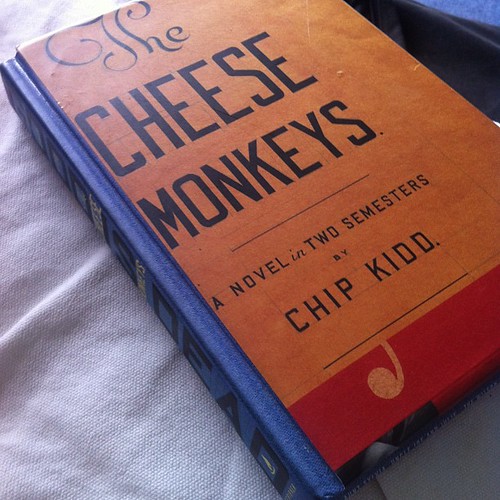
Chip Kidd’s first novel, The Cheese Monkeys, has been perhaps my favourite book of the year so far. Not the best book I read, but definitely my favourite.
It’s about a young man attending art school in late 50s America, and discovering graphic design, through a particularly memorable course – Art 127, Introduction To Graphic Design, run by one Winter Sorbeck.
I liked it for many reasons, including Kidd’s deft use of language, its acidic humour, and a description of being drunk – and then hungover – that comes close to Lucky Jim‘s. But I think I liked it most because it reminded me of the values of art school that I’ve come – very much secondhand – to appreciate. Namely: the value of the crit.
More specifically: the value of disassembly – taking apart things you know and learning how to start from nothing. Taking apart a problem to find the only appropriate answer (though there may, in fact, be many). The value of being challenged to do difficult things, and honing skills. The value of physical skills – literal muscle control – in an era before the technological overhaul of design (and the value, as ever, of being able to draw. Even just trying to draw. It helps me a lot).
And, most notably, the value of criticising the Work as the Work.
In a crit, the work may be praised, it may be criticised, it may be torn into tiny pieces, fisked until there is nothing left of it. But it is only a criticism of the Work. It is not personal, and it only criticises the Worker in so much as it criticises their efforts and production on this work. It is a magic circle for being able to critically discuss a work.
As Sorbeck’s students find, it is difficult to learn how to be in a crit, difficult to learn how to respond to one, and difficult to learn how to give one. But it’s all valuable: it is focused on making the work better. There is a degree of building a thicker skin about work required – but also a degree of understanding the difference between criticism and complaining, criticism and anger.
I went to see Bauhaus: Art As Life at the Barbican last week, and The Cheese Monkey’s fictional version of the process of learning how to see was very relevant to my reading of that exhibition: seeing an institution begin to create the beginnings of what we now see in foundation art courses around the world. I was most glad to see the early output of the foundation years at the Bauhaus – some really exciting work made by artists learning how to see form, colour, material, and texture again. The Bauhaus reminded me of all the reason’s I enjoyed Kidd’s book.
I could have dog-eared most of the second half of the book – classroom scenes and narrative alike – but there were three quotations I did end up marking, so as usual, time to share them on the blog.
p. 79, in which the narrator meets Himillsy’s architect boyfriend:
He put out his hand.
“Garnett Grey.”
Yes, Garnett Grey was an Architect. Were a psychoanalyst to approach him from behind, tap his shoulder, and say “Humanity,” Garnett’d spin around, and respond, without hesitation, “Solvable.”
p. 106, in which Winter Sorbeck explains why the title of his course – Introduction To Graphic Design – has been retitle from the Introduction To Commercial Art that is listed in the course programme.
“…I’ve been put in charge of the store here, and I say it’s Introduction To Graphic Design. The difference is as crucial as it is enormous – as important as the difference between pre- and postwar America. Uncle Sam… is Commercial Art. The American flag is Graphic Design. Commerical Art trys to make you buy things. Graphic Design gives you ideas. One natters on and on, the other actually has something to say. They use the same tools – words, pictures, colors. The difference, as you’ll be seeing, and showing me, is how.”
p.177, Winter on design and power.
“Kiddies, Graphic Design, if you wield it effectively, is Power. Power to transmit ideas that can change everything. Power that can destroy an entire race or save a nation from despair. In this century, Germany chose to do the former with the swastika, and America opted for the latter with Mickey Mouse and Superman.”
It’s a lovely book. I had a lot of fun with it.
-
David Markson left all the books he owned to New York's Strand bookshop; now, they are likely further spread. This blog collects annotations and commentary that people have found in books previously belonging to Markson. Brilliant.
-
"That’s why I like having these little printed books, or these little files of my notes, because I can literally pull up anything I want to remember from Moby Dick, and in repeating it, remember it. Annotating becomes a way to re-encounter things I’ve read for pleasure." Which is why I have a stack of eight books on my dining table, and more to come over the years – to be read, not just hoarded.
-
"Get great articles delivered to your Kindle without any extra effort." Curated content, delivered direct to your Kindle via the email interface. Will try this for a bit: it's a really obvious opening in the space, and scope for there to be many of these.
-
If you're going to write a review for a digital medium about a recursive game, this is as good a way as any to do it. Bravo.
-
"You can now browse your friends’ Liked items to find great articles to read." Instapaper now has social functionality, but it looks like just the right level of sociality for the product. I mainly use Instapaper on my Kindle, now, but will be sure to hit "like" on the stuff I'd recommend from the website. Now: to get Instapaper likes into Stellar?
-
"Built upon that sinking feeling of tuning into Radio 4 and hearing people acting at you, Radio 4b plays you a string of random programmes from Radio 4's factual archive. You might get the last thirty seconds of an episode of the Archers, but that's all. You will not hear middle-class actors tapping a teaspoon and talking about divorce."