-
"Far Cry 2 invites fatalism, pessimism, and near-suicidal tactics because optimism and strategy went on holiday to Leboa-Sako and got murdered just like everything else. Hoping for the best doesn’t work. Being clever doesn’t work. Nothing good will ever happen to you in Far Cry 2′s Africa, and none of your carefully-designed plans will ever bear fruit."
-
"The optical future of architectural ornament: light with content. <br />
<br />
That is, you get home with your digital camera and you click back through to see what you've photographed—and there are words, shapes, and objects hovering there in the street, or inside the buildings you once stood within, visual data only revealed through long-exposures." Brilliant. -
"After seeing there is a turing complete language in game, I felt like I should do something interesting with redstone in Minecraft. People already have done clocks and adders so I wanted to do something a little different while also be potentially useful. As a result, I designed out a ticker display." At least as crazy as those LittleBigPlanet calculators.
-
"Nelson, as described by IDEO in the video above, does so much work for you. It throws multiple perspectives into the equation, killing the unreliable narrator with the gifts of foresight and hindsight. It does away with the unexplainable appeal of a surprising hit novel giving you a league table of books to pick from according to their “impact on popular opinion and debate.” You’ll struggle to form your own opinion as you jump through the layers that Nelson offers you, given a perspective like a student browbeaten by an overbearing A-Level tutor." I similarly disliked their attempts to not only redesign the book, but to try to redesign narrative, in "Alice" – as if people hadn't tried, and as if what narrative _really_ needed was just a good design firm to take a crack at it.
-
"After some delay I am now proud to announce that the complete Permanent Death saga is available for download. This definitive PDF version of the story, novel, machinima, whatever you want to call it, is something I am immensely proud of. I feel it eclipses both the scope and quality of anything I’ve ever produced before." It was a lovely endeavour, and still one of my favourite games – certainly of the decade, and perhaps ever.
-
"AquaPath is a free Cocoa-based developer tool for Mac OS X Tiger that allows you to evaluate XPath 2.0 expressions against any XML document and view the result sequence in a dynamic, intuitive tree representation." It is really good, and has already saved my bacon today.
-
Spotify playlists of videogame soundtracks, and links to soundtrack albums as well.
-
Photoshoot for Empire; actors pose in pastiches of scenes for which they are famous. But with the emphasis on looking hot. Some are weak, but Christian Bale and his fireaxe, and Jodie Foster/Anthony Hopkins, are great.
-
"Natural Earth is a public domain map dataset available at 1:10m, 1:50m, and 1:110m scales. Featuring tightly integrated vector and raster data, with Natural Earth you can make a variety of visually pleasing, well-crafted maps with cartography or GIS software." Oooh.
-
"Perhaps the Shoreditch startups are more effective than their Dutch counterparts not just because they do more with less… but because they are in London. A city at a different scale than Amsterdam or for that matter the greater Amsterdam area, the Randstad as we call it around these parts. A city with a more diverse ecosystem of services and things, smaller services, more specialised services, ready to be employed by companies like BERG and RIG and Tinker, enhancing their abilities when needed."
-
"Ultimately, when I reject narrative techniques in favor of ludic ones, what I am really saying is that I reject traditional authorship. I reject the notion that what I think you will find emotionally engaging and compelling – and then build and deliver to you to consume – is innately superior to what you think is emotionally compelling. By extension, I reject the idea that I can make you feel the loss of a friend in a more compelling way by authoring an irreversible system than you could make yourself feel by playing with a system wherein a friend can be both dead and alive simultaneously and wherein his very existence can be in flux based on your playful whim… This discussion is not about how to make a game more meaningful. It is about how games mean." Yep, I still want to marry Clint Hocking.
-
Clint Hocking's presentation materials – talk, slides, short mpeg – from his GDC09 lecture, "Fault Tolerance: From Intentionality to Improvisation". It's meaty and weighty and it's really, really, really good, and covers lots of bases and I'll need to read it again. Lots of dense stuff about the balances between Far Cry 2's gameplay systems, designing systems for improvisation, and rebalancing games to what they want to be. My mancrush is not abated, sadly.
-
"Mastery is not a prerequisite to improvisational play. The only prerequisite is confidence, and the only prerequisite in making the game is that we do not discourage the player from improvisation by "humiliating" the player." This talk really does sound like it confirms what I already know: Hocking is bang on a lot of money, very self-aware, and I want to give him consensual manhugs. Also, I want him to make more games. Lots more games. Curses at not getting to GDC.
-
John Carmack writes about porting Wolfenstein 3D to the iPhone – there's a lot in here that's very interesting, and some smart notes on design and interface choices; there's also some Carmack Being Carmack. Still, he's an impressive developer, and it's nie to see someone being so open at development, especially for the iPhone
-
"Tattoos from books, poetry, music, and other sources." As with all tattoos: some are misspelt, some are a bit blah, some are beautiful.
-
Pup ponders the heat-death of the universe. Beautiful, and a lovely use of space, too.
-
"CRM training encompasses a wide range of knowledge, skills and attitudes including communications, situational awareness, problem solving, decision making, and teamwork; together with all the attendant sub-disciplines which each of these areas entails. CRM can be defined as a management system which makes optimum use of all available resources – equipment, procedures and people – to promote safety and enhance the efficiency of flight operations."
-
Scrapes lots of things, produces a useful page which actually manages to stay up. Also, it spells TRANSPORT CHAOS the only way it should be spelt: in capitals.
-
Named for the year the BJP was founded; nicely written, and not just a fast-moving press release stream.
-
All Kenta Cho's code on wonderfl.
-
Kenta Cho's making stuff on wondfl, in ActionScript. This example is ASCII-based bulletty goodness.
-
"So perverse as it might sound, I'm going to plead for less choice in video games. It's a paradox: by limiting the player's discretion, you can expand the narrative possibilities of the medium. Coercion can create a kind of emotional heft that you can't achieve within the confines of the empowerment-myth." All true, and FC2 is a fantastic example of this. But: this is just one way of making games. More of this, yes, but don't forget all the other approaches.
-
"write Actionscript3 code in a textarea, and your code will be compiled server side. Your compiled Flash will be reloaded automatically in the right side of the page, so write code and see it real-time." And you can fork other people's code. It's like github and Heroku all at once, but for Flash.
-
"Obama Says: Yes We Can is a Simon Says game based on Barack Obama's New Hampshire Primary speech, as later turned into song by will.i.am. Watch the game create a pattern of button and direction presses, and repeat that pattern correctly to score! The more you get correct, the harder the patterns become – can you keep up?" Oh blimey.
-
Lots of good stuff in here I didn't know about, all for your DS, and all not illegal. Hurrah for homebrew.
-
"With DS Reader you can read any e-book (or text file) on your DS. It even has a great little bookmarking function to keep track of your progress." Ooh.
-
"Game Trivia Catechism is a multiple-choice trivia game, testing your knowledge of video gaming. It can be played as straight trivia, or as part of a story that follows Al and Sally as they compete in the King of Game Trivia Tournament." Looks awesome.
-
"Current mass-market games present simulations of incredible fidelity. Many of these titles also push genre boundaries and offer new mechanics to players. The problem, argues Ubisoft’s Patrick Redding (FAR CRY 2), is that these two developments are disconnected. Game output appears information-rich, but how much of that information can the player actually use to play better, and how much of it is just there to be spectacular or cinematic?" I would pretty much kill to see this. Gah.
-
For those of you who might not be aware of its size, James has put the size of Gaza in context through comparing it to maps of other cities. Simple, effective communication.
-
"in the meantime, I decided to do an absolutely crucial bit of game science. Something that I am entirely sure is mulled over constantly, but never properly investigated. The question is but stated thusly: how long would it take the Little Prince to roll up an entire room based on a random path algorithm?" Julian is having fun.
-
"Take it easy on the kid, SilverFox316; everybody kills Hitler on their first trip. I did. It always gets fixed within a few minutes, what's the harm?"
-
"For all the talk of immersion and realism it seems gamers still want games that provide for them, that make them the centre of the action, the pivotal agent in the events of the world, the nexus around which everything is focused." And this is one of the big conflicts within games: you have to make the player feel wanted whilst they're playing the game, make them feel the centre of attention, because without them the game is nothing. But at the same time: can you still tell stories that aren't about them? I expand a little in the comment on the blogpost proper.
-
"Over the past few months we’ve had to create a few iPhone mock ups for presentations… Since we know we’ll be doing more of this, we created our own Photoshop file that has a fairly comprehensive library of assets – all fully editable." Could be useful.
Favourite Games of 2008
24 December 2008
It’s the end of the year, and that means time for lists. My books and albums lists are forthcoming – hopefully tonight or tomorrow – but in the meantime, I thought I’d kick off with ten of my favourite games of the past year.
There’s lots missing here, mainly owing to the fact I haven’t finished a lot of recent titles or given them the time they’ve deserved. What this is, though, is a good summary of what the gaming year felt like to me; ten games I enjoyed a great deal, and that I would recommend in a heartbeat to anyone not sure where to begin with 2008.
And so, in no particular order:
Far Cry 2
(Xbox 360, PS3, PC)
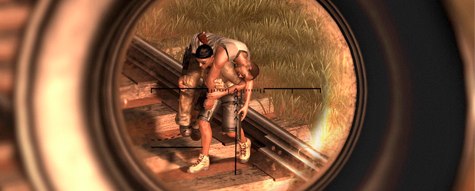
I have written enough about this already, but suffice to say: it sunk its teeth into me, after the initial hump I couldn’t play anything else, and at the end, it left me unable to play anything else for a while. Spectacularly beautiful, too.
Trism
(iPhone)
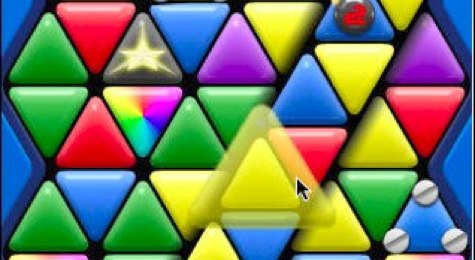
Trism began as an app for the jailbroken iPhone; it quickly made the transition to the official App Store platform when that opened up, and it has sold hundreds of thousands of dollars of copies since then, giving Demiforce a fantastic start to their company. And with good reason: it’s a great piece of game design, easy to learn, and hard to master. It also makes brilliant use of not only the iPhone’s capacitive touch screen, but also its tilt sensor. It’s a very pure puzzling experience, and I’ve already sunk many hours into it; it suits the pick-up/put-down rhythm of travel and play on-the-move idaelly. If you have an iPhone or iPod touch, this really is a no-brainer.
Geometry Wars Retro Evolved 2
(Xbox 360)
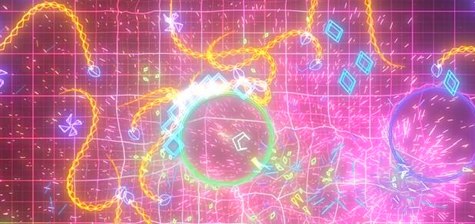
It’s still one of the best games on Live Arcade. It’s also still one of the best asynchronous multiplayer games you can play. Making your friends high scores the default high score table gives it a great competitive streak and really contextualises your performance: nothing’s more frustrating than having emailed a friend to say “hah, beat your high score” only to receive an response five minutes later informing you that the ball is firmly back in your court.
Adding variety to the original formula are the six game modes, slowly unlocked over time. They may all be variants on a theme, but they all still demand unique skills and become games in their own right: turning the Pacifism achievement from the first game into a mode in its own right was a great move.
Beautiful in high-def, easily explained to anyone who’s played a videogame in their life, it’s by turns accessible and challenging, and an essential purchase for new 360 players. Also, its social scoreboards give it great longevity, and prove what I already know: I’m nearly, but not quite, at the bottom of the pack when it comes to motor control. As long as I’m not last…
Braid
(Xbox 360)
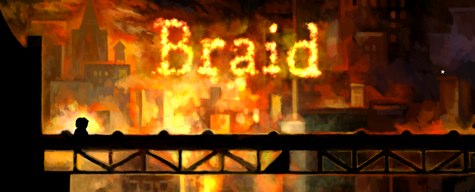
If there’s a measures of Braid’s success, it’s not to be found in its sales or metacritic scores, but in the sheer volume of verbiage devoted to it in the blogs, forums, and magazines of the gaming world. Thousands of words, all expended on the game, on the hype, and on what the hell it all means.
It wouldn’t have got that discussion if it wasn’t in some way good, and it really is: beautiful, challenging, and proof of the things that only games can do. It embraces game-native storytelling, wrapping its meaning tightly around its mechanics, and tells its tale through challenging, timeless puzzles and David Hellman‘s incredible artwork.
Perhaps it is a little pretentious; perhaps the writing is weak. Regardless of those facts, it’s exciting to see a game like this getting such a major launch on a mainstream, living-room platform, and as an artefact to push forward the casual – as well as professional – criticism of games, it’s a great starting point.
GRID
(Xbox 360, PS3, PC)
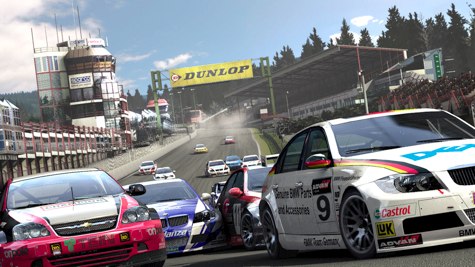
I always forget how much I like racing games. GRID is a very, very fine take on the racer. It’s beautiful, it’s fast, and it’s totally stripped down. GRID demonstrated that Codemasters really understood what making a game “cinematic” might look like: you condense it down into tight, exciting drama. So races take place over two-to-five laps, and in that time the AI will give you as good a catfight as any “realistic” simulator might over an hour. The rewind-time mechanic, as well as being wonderful to watch, removes the traditional racing-game reliance on the “restart” option; giving the game a pre-credits race, not to mention an ongoing narrative of running a team only helps with the Days of Thunder feel. Mapping Le Mans to a twenty-four minute endurance race makes it both exciting and endurable.
And, of course, it’s very pretty and fast as hell. The open-wheel racing is some of the most exciting driving games have to offer, in particular. The drift tournaments are weak, but stick to the touring cars, touge and open-wheel and you’ve got a hell of a game. The icing on the cake is the beautiful, free-floating typography. Solid, and surprisingly good.
Grand Theft Auto IV
(Xbox 360, PS3, PC)
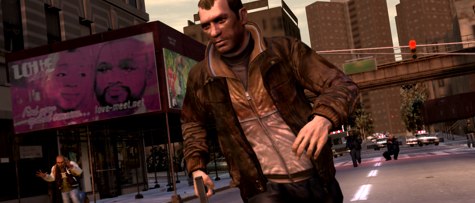
It’s on everybody else’s list, and I can’t really deny it: it’s a wonderful environment, and a staggering achievement. It’s not as smart as it likes, and it occasionally misfires but it delivers moments by the dozen. Shame the pacing of the islands feels wrong – after the majesty of Three Leaf Clover, being dumped in the New Jersey analogue is a bit underwhelming.
Also: multiplayer, with the right gang of people, is a total hoot. Whilst not the runaway online success that might have been hoped for, if you can get eight to sixteen friends online together, Cops and Crooks or Turf War will bring the fun pretty fast.
God of War: Chains of Olympus
(PSP)
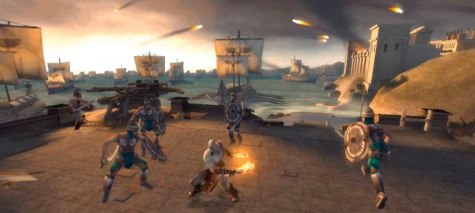
Well, it came out this year in the UK. I played this sitting by a roaring log fire, having spent my days clambering around the Lake District. It is not the greatest game of the year by a long stretch. It is, however, a wonderfully crafted experience: short it may be, but it’s put together almost perfectly: fantastic environments that barely repeat, thrilling combat that’s not too difficult, and one of the most striking in-game sequences I’ve played this year. It helps that the lack of direct camera control translates perfectly to the single-stick PSP. On top of all that, it looks almost as good as the PS2 versions – it’s a remarkable feat of engineering. I had a lot of fun with this, and if you own Sony’s much-unloved portable, you owe yourself to play this.
Left 4 Dead
(Xbox 360, PC)
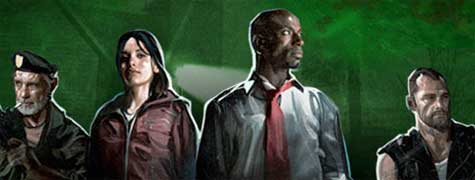
Gerard Way asked if it was any good, and the answer is yes, Gerard, it is. It’s bloody brilliant, although with the obvious caveat that it gets better with friends. Co-op gaming has slowly seen a slew of support and innovation in the past two to three years, and Left 4 Dead represents one particular pinnacle of that: an experience designed ground-up to be played not only co-operatively, but with real friends.
It’s not about team-mates, it’s about mates; how far would you go to save your friends from a Smoker? Quite far, as it turns out; I’ve noticed that in various pick-up groups, if I have to pick between someone I know in real life and someone I don’t, I’ll go with my friends first. To see such an unashamedly co-op experience – and one that could be described as reasonably hardcore if you hadn’t tried it – achieve such a level of mainstream success is very heartening. I put it down to the fact that Valve are such a talented gang of people, and so fastidious in their process. If you’ve not played through the director’s commentary, you owe it to yourself to do so, if only to understand that nothing in the final product is the result of chance.
Also: it’s great to see a game that puts the mechanic, indeed, the core technology, that really makes it – the AI – so far front-and-center. Personifying it as the AI Director was the stroke of genius that not only made players aware of it, but gave them someone to blame when they all died. Again.
World of Goo
(Mac, PC, Wii)
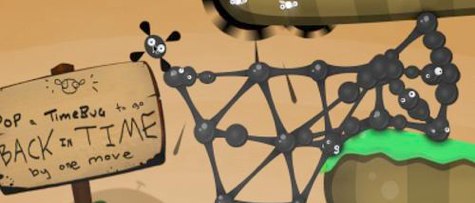
There are two reasons, I think, that World of Goo has captured a lot of people’s hearts this year. One is the game itself: the wonderful art; the delightful soundtrack; the just-one-more-go gameplay that carefully teaches you everything to know whilst keeping the challenge just high enough. But the other is the game’s mythology: 2D Boy, two guys working out of coffee shops for a year, giving up on the traditional industry to make the game they really wanted to. It’s the story we all wanted to believe in. The fact that both elements are so great is the real magic of World of Goo: risking it all, living the indie dream, really did lead to a wonderful game.
Gravitation
(Mac, PC, Linux)
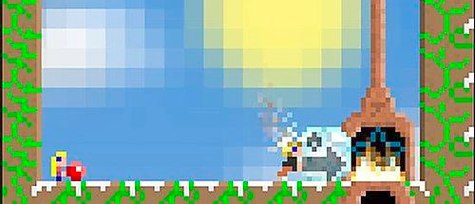
I like this more than Rohrer’s previous Passage. It’s a small, simple game, available for most home desktop platforms (Windows/OSX/Linux), about “mania, melancholia, and the creative process”. To say any more is to rob it of its impact. Once I worked out what you have to do to progress, I played on with a huge lump in my throat. To be heartbroken by a game this slight, this simple, in its 100 square pixel area, is quite something, and Rohrer makes games like no-one else.
Africa Wins Again: Far Cry 2’s literary approach to narrative
22 December 2008
Far Cry 2 is a difficult game to write about; difficult because it’s an experience that doesn’t coalesce in individual moments or fragments. Whilst there are many memorable moments I can point to – the dynamic, emergent gunfights that characterise the gameplay, the starkness of the major plot beats – it is the player’s overall experience of the game that is its greatest strength.
And isn’t that how things should be? For a game that revels in the open world that it’s set in – a fictitious African country that covers desert and mountain, swamps and savannah – it only seems appropriate that it be a game about the impact of a world on a character, rather than that character’s interactions with the world. Far Cry 2 takes the mechanics of its open-world shooting experience, and works out how to wrap them into a much larger narrative without losing the coherence of the player’s actions.
Far Cry’s references to Conrad (and, in particular, Heart of Darkness) are well-documented already, but I think to focus on the words used, the plot the game follows and the references within the game so explicitly isn’t necessarily useful. What struck me was not the game’s similarity to Conrad; it its much broader, deeper appropriation of literary techniques – whilst using them in an inherently gamelike manner – as a way to tell stories.
(Before we go on: there are likely to be what you might call “spoilers” ahead, so there’s a break in the text for those of you viewing on the web. I don’t see how we can talk meaningfully about this game without talking about specifics, so if you’ve not finished it and really care about this kind of thing, look away now.)
Continue reading this post…