Blog all dog-eared pages: Cooking In A Bedsitter, by Katherine Whitehorn

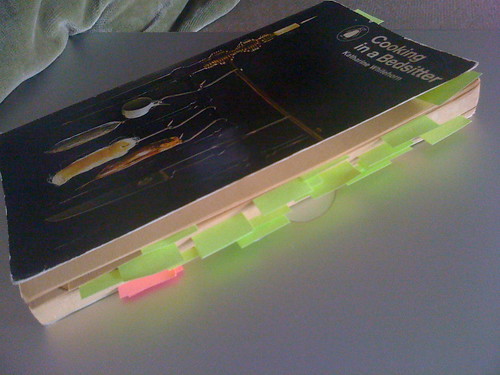
The beautiful cover, of cold cuts hanging from a bedstead

When I moved house recently, I managed to find my copy of Katharine Whitehorn’s classic Cooking In A Bedsitter. Almost everyone I’ve shown it to has loved it, and asked for me to put more of it online, and so Easter Weekend seemed as good a time as any to dog-ear some pages.

Whitehorn’s book was first published in 1961, and targets the early twenty-somethings moving into small bedsits with the advent of first jobs; her goal is to point out that you can cook perfectly well – even rather entertainingly – with a single gas ring and no sink, but you’re not going to be cooking like mother – and you’re going to have to be a little bit creative.

What follows is a selection of simple, cost-conscious and clearly explained recipes for the first-time bedsitter cook. They are accompanied by Whitehorn’s barbed tongue and voice of expertise, although she barely lived in a bedsit, and didn’t really enjoy cooking, as this interview with Rachel Cooke from last year’s Observer details.

There are two sections to the book. The first, “Cooking To Stay Alive” is a crash course in cookery, storage, inventive use of space and savvy cooking. The second, “Cooking To Impress”, looks at how to cook for parties or groups or, most importantly of all, objects of affection. It’s here that Whitehorn’s pragmatism combines with a saucy barb and, frankly, makes me laugh very hard.

Anyhow, it was hard not to copy out the whole book, but I’ve tried to be reserved to give you an idea of what you’re missing. Do buy the book – it’s still in print, although without the delightful cover of the Penguin edition – if only for a slice of cultural history, when bedsits weren’t last resorts and we were still learning what to do with tinned food. Also, because it’s funny, as I hope you’ll see. I’ve tried to not quote the recipes as much as the text, if only to make it worth your while buying it.


p.13, introducing the notion of cooking in a bedsitter:

“it is a sad fact that the better the room itself and the house in which it is found, the worse the cooking problem tends to be. In a large squalid rooming house, where the landlord calls only to collect the rent and where the cleaning, if any, is done by an indifferent slut with no standards to maintained, adventurous cooking is perfectly possible… if you fill the whole house with the smell of burning onions you will be cursed but not evicted; and nothing will look much worse whatever you spill on it”.

p.14

“it is a common fallacy among the better class of landladies that one can exist entirely on tea, biscuits, and good books, without the need for food, beer, the wireless, or the companionship of the opposite sex”

“plenty of our troubles are of our own making. So many of us go into bedsitters, at least in the first instance, with the attitude of ‘me all alone in my little room with my little pan and my little spoon’ – and small pans, of course, make things ten times harder when you have only the one ring on which to cook everything you want to eat. Much better to think ‘me with my enormous appetite and my huge stewpan’.”

p.15, on learning to think like a bedsitter cook:

“The first thing a bedsitter cook must do is abandon the notion of ‘meat and two veg’, in favour of the idea of a simmering cauldron. Meat, yes; vegetables, certainly – thought it might be one or it might be four – but meat and vegetables deliberately chosen to be cooked together, so that the dish is all the better for one food sharing its flavours with another. And that brings us, inevitably, to the casserole.”

p.19, on arranging the room:

“You can save yourself a lot of trouble by deciding that one corner of the room is to be wholely given over to food. College girls who hide their cosmetics in their desks usually look as if they didn’t bother about their faces; by the same token, if you care about food, don’t hide it.”

p.20, explaining just what you really need to run a small kitchen:

“A good many cookery books start out by requiring a vast battery of equipment without which the simplest dish is doomed to failure. (I always burst into tears when I get to the bit about the little porcelain ramekins). But here it is not a question of the best possible tools, but the fewest… the right simple tools will stop you longing for the other, complicated ones.”

p.51, an early recipe illustrating just how simple some of the recipes are – and just how basic the ingredients:

Sausage and Smash

4 pork or beef sausages
a little fat
1 tin condensed vegetable soup

Fry sausages over medium flame 10 minutes; pour contents of tin into pan, and stir until heated, 3-4 minutes.

p.55, a recipe from the rather creative section on what you can do with bacon:

Dixie Casserole

2/3 rashers bacon
1 small tin sweetcorn
2 eggs (optional)
1 dessertspoon flour
1 cup milk or less

First hard-boil eggs if you are using them. Then fry bacon until crisp; pour off fat till about a tablespoon remains. Add flour, over gentle heat, till fat is absorbed. Add liquid from tin, gradually, and then milk until you have added one cup in all. Stir until it thickens; add corn, bacon, and halved hard-boiled eggs. Simmmer 10 minutes.

p.63, introducing the section on vegetables:

“If meat costs 3s. 6d. a pound we think it cheap; if vegetables cost 3s. 56d a pound, we think them dear. Moral: eat vegetables.”

p.79, introducing the section on Beef:

“Most cookery books begin with the portrait, in profile, of the Planned Cow. This amiable beast is covered with dotted lines, like a map; and the idea is to show the uninitiated where their piece of beef should come from. I am sorry to deny my readers this pretty sight. But the trouble with the Planned Cow is that it looks so totally unlike the nameless red hunks that actually appear on the butcher’s slab. It is really more use to know what it looks like when you buy it than to know what it looked like when it was somebody’s mother (or son).”

p.100, on curry:

“Curry finds itself in this section because it is useless to try to impress anyone with a curry nowadays unless you have spent several years out East and are prepared to talk about it, as well as cook, for hours on end. When it comes to really elaborate curries it is much better to be on the receiving end, and fortunately most people who live in bedsitters know at least one Indian or Pakistani who is delighted to make a curry for an admiring friend. moreover, they are apt to know their proportions only in terms of .01 grains of saffron per half sheep, so that they will often make enough curry for you and everyone on the staircase to feed off for a week.”

p.143, introducing “Cooking to Impress”:

“Impressing visitors can usually be done in two ways: the Lavish and the Casual. For you in your bedsitter the lavish is impossible… instead you must concentrate on the apparently effortless meal – the attitude of ‘just a little thing I seem to have cooking in this pot’… if your guests are not to see you looking flustered over your cooking, this in practice means they had better not see you cooking at all.”

p.145, outlining a few important things to do first:

“3. Get yourself looking nice. In a house you can disappear and finish dressing – in a bedsitter, no. Besides, you want your friends to think that dark-eyed look is all Soul, not just mascara; and they won’t, if they see you putting it on.”

p.147 – “Who Are You Trying To Impress?”. Visitors come in four categories:

“1. The troglodyte in the next bedsitter.
2. Couples, or mixed singles, who are accustomed to kitchen food and drawing-room standards. They have forgotten what it was like to cook in a bedsitter (if they ever knew), and it is your business not to remind them.
3. Your parents, or your parents’ spies – who are there to reassure themselves that you are eating adequately, get to bed early, know no vicious young men, and breath plenty of clean fresh air.
4. Delicious little parties à deux.”

p.148 – Cooking for a Man:

“Elementary rules: avoid all whimsy and complication in the food.”

and later on:

“Don’t apologize much if anything goes wrong; don’t flap, whatever happens, and NEVER ask ‘Is it all right?’”

Ah,” said a friend when I showed them that section; “that sounds a lot like sex.

Of course, the elementary techniques described do not always apply:

“There is one class of man for whom a quite different routine is needed: the richie who has up till now bought you expensive meals in smart places – often your only decent meal that week – and now, to your horror, wants to get to know you better in your own surrounds. You don’t want him to think that you can’t be bothered to cook for him, or can’t stand him around the place, or else he will naturally never ask you out again. But equally, neither the food nor the atmosphere must be so inviting that he decides to give up eating out altogether in favour of eating in. The dodge here is to reverse the normal procedure, and fuss up and down constantly… he will quickly conclude that your own surroundings hold little promise for him, and go back to taking you to Boulestin’s, or of course luring you back to his own lush flat. Well, at least he has to see to the food there.”

p.149 – Cooking for a Girl is somewhat different, Whitehorn explains:

“You, as a man, can get away with more roughness than a girl can. But if you are seriously luring the girl, you have a dilemma: you certainly don’t want to give her the idea that you are struggling to impress her, but of course she will be touched and appreciative of any sign that shows you have remembered who it is you are feeding. The right compromise is to imply that you set yourself rather high standards of food; but add, almost as an afterthought, something of purely feminie appeal, like sticky chocolates or her own special brand of Turkish cigarettes.”

p.173 – The final chapter, on “Drink And Parties”, was “contributed by a man” – specifically, Whitehorn’s husband, Gavin Lyall.

“It should be news to no one that red wine goes with red meat and most game; white wine with fish, veal, and the sweet courses. More to the point, perhaps, is that white wine goes with carpets; red wine only with floors you can wipe clean or don’t need to care about.”

p.175, on Parties:

“There are only two rules for parties: the carpet rule redoubled in spades, and don’t mix the drinks.”

p.177, on serving Spirits:

“Spirits cost money. Pubs reckon getting 32 measure from one bottle (so you can work out a rough idea of their gross profit), but I shouldn’t go giving your friends pub-sized measures if you want them to stay friends.”

p.178

“There is nothing against having beer for the men and gin for the women – if you can keep the men away from the gin.”

As I said earlier; it’s a wonderful book, and the recipes in it vary from useful, fast snacks to ingenious dishes that might well become staples in time. And it’s worth it just for Whitehorn’s wonderful, barbed tongue.

Blog All Dog-eared Pages: This Gaming Life, by Jim Rossignol

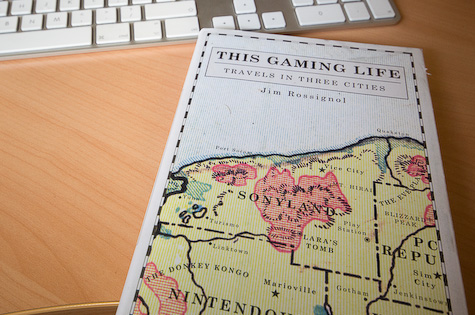
This Gaming Life (cover)

One of the books I read on my holiday in Pembrokeshire was Jim Rossignol’s This Gaming Life. I’d been meaning to get around to it for quite a while, and finally did so once it was revealed that the (beautiful) hardback edition was nearly at the end of its print run.

It’s an interesting book, if perhaps somewhat flawed. This Gaming Life is games writing filtered through the lens of travel writing; the “three cities” of the title being London, Seoul, and Rekjavik. “London” feels a little weak, and disjointed; the focus on Splash Damage is reasonably strong, but is perhaps not connected enough horizontally. It is also a reminder of the book’s strong leaning (understandably, given Rossignol’s expertise) towards PC gaming. As a result, certain PC-centric aspects of games such as modding cultures are praised perhaps a tad more highly than I think is reasonably within the bounds the text sets itself.

Seoul is more interesting, if only because it’s much more alien to most readers. There’s some strong insights and good anecdotes here, and it stands alongside Rossignol’s original PC Gamer article on gaming in Korea well (available in PDF form here).

The strongest section of the book is the final half, which is set in Rekjavik and focuses on CCP and their massive online game EVE Online. Rossignol is well versed in EVE and a keen player of the game, and it really shows – there are so many good stories, personal anecdotes combined with objective criticism, that the book leaps to life in this section. Part of me would love to have seen the other two thirds as long, and as strong, as this; the other part of me would love to see Rossignol just drop 300 pages on EVE, because it’s obvious he could, and it’d be an essential piece of criticism and historiography. Maybe that’s on the way.

But, despite its flaws and occasional ponderous prose, I really liked the book. There’s lots of good stuff in here, and I was pleased with the notes I came away with (see below).

It feels a little out of place in a book so fixated on PC gaming, but the “playlist” Rossignol provides at the end of the book is fantastic: a list of games that, whilst obviously never going to be conclusive, represent a good way into games for the uninformed. His selection is strong, and his writing about each of the titles is joyful and unpretentious; most of them require either a PS2 or a PC, and I can hardly argue about many. It’s nice that it’s there, even if only as a reminder, at the end of the book, that all the writing in the world won’t matter if you don’t play the damn things.

Most of all, though, I’m just glad books like this can exist. It’s published through the MIT Press University of Michigan, and I really hope it sets the scene for more writing on games like this. It’s grown-up, personal but not gonzo, multi-disciplinary and prefers rational, informed, and sometimes unresolved discussion over snap judgments and pithy soundbites. This, to my mind, is a format that suits games writing (not just criticism) incredibly well, and I hope that UMICH Press (and their competitors) seek to comission and publish more work like this, because it’s important that games starts to establish a second-order culture of criticism as well as a first-order culture of play.

I feel like I’m being harsh on the book earlier, but really, that’s just because it’s an early entry in this space, and it’s for that it needs to be praised. I have no doubt that Rossignol has even more – and even better – writing to come, and I’m looking forward to it eagerly. In conclusion: definitely recommended, but with what I think are reasonable reservations. Also, the less-well versed you are in some of the topics he discusses, the more essential a purchase I think it might be; perhaps my reservations are coming from someone too deep inside the topics he discusses.

As is traditional in such threads, here come the quotations that I found, for whatever reason, worth turning a corner over near:

p.30, on boredom:

“use of the term boredom has increased ceaselessly since the eighteenth century. It cannot be found in English before 1760, and although [Lars] Svendsen notes that some European languages came up with equivalent words in the centuries before, they were generally derivations of the Latin for “hate” and carried similar meanings”

p.43, on some of the motivations for writing the book:

“My travels had begun to reveal that almost all writing and reporting concerned with gaming overlooked what the experience of gaming had meant to the gamers themselves. There was some talk about the intellectual or cognitive experience, but how games slotted into different lives and how they changed perceptions and agendas was being ignored”

p.52, Leo Tan talking about playing Guitar Hero at the Donnington Rock Festival:

“…playing Guitar Hero on stage is a completely different experience to playing at home. At home, you might feel like a guitar god; but on stage, people are screaming, and when you come off, they swamp to the sides to try to talk to you. It’s exhilarating in a way that I’ll never experience elsewhere. And it was a game. And everyone knew it was a game.”

p.73, on televised pro gaming:

“gaming remains and awkward spectator sport. It’s an interesting avenue of possibility for a small clique of gamers, perhaps; but the low number of people who watch video games played by the pros outside Korea suggest that the most important aspect of gaming is its interactivity. I’ve seldom been as bored as I have been watching pro gaming tournaments, especially when they’re for a game I’m actually interested in playing. For these reasons, I believe that Korea’s televised Star-leagues reflect a cultural singularity within Korea, not an indication of where global gaming will go in the future.”

p.76, on the real-world communities and companionships forged through online gaming:

“Thanks to games, [Lee] In Sook [a high-level Lineage II player]’s circle of friends had ended up talking, becoming close, and then making sure that they hung out at the same cafés to play at the game games. Online games create shared experiences that are unlike those we might have in the real world. This is a quality of the medium itself – players who might not excel in conversation might feel confident in text chat.”

p.77, on the nature of those communities forged within games:

“Online games are usually far more like teeming cosmopolitan cities than stable provincial communities: the mix of people is enormously diverse, and you often find yourself being ignored by passersby or even accosted with unsettling propositions. You aren’t sure who to trust, and many gamers will depend on previous acquaintances or real-world friendships as the basis for in-game socializing.”

p79:

“Games stand to change not simply individual imaginations or personal finances but the possibilities for interaction and socialization across our different cultures. This is no grand cultural revolution: it is a subtle wave, a gradual tectonic shift in the way we live, which will only make its true effects known over the course of many years… chasing headlines that read ‘Games Are The New Sport’ or ‘Kids Who Play Games For A Living’ makes a crude statement about what really matters within gaming. The important changes will come from those smaller ripples that change how millions of people live, think, and socialize on a daily basis, not just the hard-core niches.”

p.93, on how games manipulate and inspire our imaginations:

“The in-game slaughter of the attendees of a funeral held for a deceased World of Warcraft player presented a case of quite spectacular insensitivity. It revealed a significant swathe of gamers who radically failed to sympathize with their fellow gamers, treating them as little more than moving targets and ignoring the real-life tragedy they were trampling on. Perhaps, however, they were simply acting within the narrative conventions that the game delivered to them. Their game belonged firmly within the genre of bad guys versus good, and they played the bad guys. Had it been a game about tragedy and human loss, the gamers’ responses and actions might have taken on quite a different character.”

p.100, quoting Kieron Gillen on simulation:

“‘Battlefield 2 presents a beleaguered United States in a war that is more cowboys and Indians than anything else, while Operation Flashpoint reaches for something more akin to a comment on the nature of war using theoretical examples’… as Gillen observes, ’simulation is expression’”

p.102, leading into discussion of Luis von Ahn and his ESP game:

“Game creators don’t have to speak to gamers at all, nor do they necessarily have to persuade them of anything. It is simply by letting gamers get on with playing that they really begin to change the world. To me, this idea is one that seems far more radical than molding games into old-fashioned propaganda: it is the notion of using games for the purposes of ‘human computing’”

p.106, on one kind of propaganda present in games:

“The danger of games, [Chris] Suellentrop suggests, is that they teach us that success means discovering and then following the rules – a deeper genre of propaganda. If he’s right, then the ever-growing millions of obsessed gamers could eventually be playing their way into a new and subtle kind of oppression, something far more worrying than finding their ‘wasted cycles’ put to use in the technology of a major corporation’s search engine.”

p.145, on “use models”:

“Will Wright observed that unless you actually play games, it’s hard to judge what is happening to a gamer. ‘Watching someone play a game is a different experience than actually holding the controller and playing it yourself. Vastly different. Imagine that all you knew about movies was gleaned through observing the audience in a theatre – but you had never watched a film. You would conclude that movies induce lethargy and junk food binges. That maybe true, but you’re missing the big picture.’(Wired, April 2006)”

p.147, more Will Wright (from a conversation with Brian Eno):

“When we do these computer models, those aren’t the real models; the real models are in the gamer’s head. The computer game is just a compiler for that mental model in the player. We have this ability as humans to build these fairly elaborate models in our imaginations, and the process of play is the process of pushing against reality, building a model, refining a model by looking at the results of looking at interacting with things.”

p.150, applying Wright’s model to EVE Online:

EVE is a shared mental model in the heads of both thousands of gamers and dozens of developers, with a process of feedback moving cyclically between all those involved. The mental model is not htat of one person engaging with a singl emodel on a personal screen, but a picture comprised of tens of thousands impressions of the same model… [EVE] is a single collaborative imaginative enterprise that exists in real time… those who have had time [to sink into playing and exploring EVE] have begun to uncover something remarkable and one of the possible future directions for gaming: entertainment that is also massive collaboration.”

p.170, on LittleBigPlanet (which, at the time of writing, was still in production). I particularly liked this simple turn of phrase:

LittleBigPlanet presents games as malleable, communicable objects, built for gamers to customize and distort as they see fit.”

Communicable objects” seems about right.

p.171, on Tringo:

Tringo had become a leaky object: moving between physical and virtual realities seamlessly. It was a virtual entity that had become a physcial product, while still making money within a virtual world.”

Again, “leaky object” is very good.

p.181, quoting Julian Dibbell:

“Dibbell makes a powerful case for the contemporary social and political importance of virtual interactions, as well as summing up something about thei weird, hybrid nature as both games and monetary systems: ‘Games attract us with their very lack of consequence,’ Dibbell wrote in Wired magazine, ‘wheras economies confront us with the least trivial pursuit of all, the pursuit of happiness.”

p.183, on the shape of online gaming groups such as clans or guilds:

“…it seems that they are becoming more like actual communities or tribes. Like entertainment-seeking nomads, they move from one game to the next. If the future of games ends up being focused on user-generated works, then we will probably join projects because we like gaming with particular people we have met elsewhere. We might like the look of what they are making or how they are influencing the game world they plkay in, but it’ll be the gmaers themselves that reinforce our commitment or define how our gaming is experienced.”

p.192, on what might be described as the journalist’s dilemma:

“I am caught between my personal interest in the games and the gamers who play them, on the one hand, and the billion-dollar business machine for which I have become a regular mouthpiece, on the other. I am troubled by the idea that games have to have some greater purpose than entertainment, and yet I am enthralled by the idea that they cabn be used as propaganda, art, or medicine. I want to spend all my time exploring the peculiar physics of a new game world, and yet I am compelled to write about and describe it for money.”

Blog all dog-eared pages: Regarding The Pain Of Others, Susan Sontag

Regarding the Pain of Others is a long-form essay by Susan Sontag, examining the representation of suffering (and notably warfare) through the display of photographs. Published in 2003, in many ways, it is a follow up to some of the ideas examined in her earlier On Photography.

On Photography is one of my favourite books on the subject; it made a deep impact at university, and I’ve been meaning to reread it for a while. Regarding the Pain of Others is interesting if only because (as later illustrated) Sontag revisits some of her arguments in that set of essays and questions them again, even disagreeing with her younger self – something that I’ve rarely seen a critic do.

It’s a slim book – around 100 pages – but it’s written very densely, with long, unbroken sentences and many subordinate clauses. At times, it feels like the book as a whole could have done with its screws being tightened, but Sontag’s language is clear and efficient; it was hard to quote short passages simply due to the number of themes being rammed together in single constructions. It clearly also took me time to get into it – most of my dog-eared pages are in the latter half of the book, even though there’s almost as much I could quote from the first half.

A worthwhile read, anyhow; lots of thought about the current media landscape, especially in America, even if at times Sontag is somewhat pessimistic about Western society as a whole. Despite it not being the easiest – or clearest – book to read on the train to work, it had a lot to say that resonated, and it provided much-needed historical context for the media of today.

On to the quotations:

p.60, on the similarity of “shooting a subject” and “shooting a human being:

“War-making and picture-taking are congruent activities: ‘It is the same intelligence, whose weapons of annihilation can locate the enemy to the exact second a meeter.’ wrote [Ernst] Jünger, ‘that labors to preserve the great historical event in fine detail.’”

p.67, on the contradictory nature of photography-as-reportage and photography-as-beautiful-artefact:

“The concern is that the images to be devised won’t be sufficiently upsetting: not concrete, not detailed enough. Pity can entail a moral judgment if, as Aristotle maintains, pity is considered to be the emotion that we owe only to those enduring undeserved misfortune. But pity, far from being the natural twin of fear in the dramas of catastrophic misfortune, seems dilute – distracted – by fear, while fear (dread, terror) usually manages to swamp pity. Leonardo is suggesting that the artist’s gaze be, literally, pitiless. The image should appall, and in that terribilità likes a challenging kind of beauty.”

p.70, on Sebastião Salgado’s portraits:

“It is significant that the powerless are not named in the captions. A portrait that declines to name its subject becomes complicit, if inadvertently, in the cult of celebrity that has fueled an insatiable appetite for the opposite sort of phootgraph: to grant only the famous their names demotes the rest to representative instances of their occupations, their ethnicities, their plights.”

p.76, on the familiarity of certain photographs as cultural artifacts:

“…photographs help construct – and revise – our sense of a more distant past, with the posthumous shocks engineered by the circulation of hitherto unknown photographs. Photographs that everyone recognizes are now a constituent part of what a society chooses to think about, or declares that it has chosen to think about. It calls these ideas ‘memories’, and that is, over the long run, a fiction. Strictly speaking, there is no such thing as collective memory – part of the same family of spurious notions as collective guilt. But there is collective instruction.”

p.79, on the nature of memory (and with an awkward opening line, to say the least):

“Even in the era of cybermodels, what the mind feels like is still, as the ancients imagined it, an inner space – like a theatre – in which we picture, and it is these pictures that allow us to remember. The problem is not that people remember through photographs, but that they remember only the photographs. This remembering through photographs eclipses other forms of understanding, and remembering.”

p.94

“In the first of the six essays in On Photography (1977), I argued that while an event known through photographs certainly becomes more real than it would have been had one never seen the photographs, after repeated exposure it also becomes less real. As much as they create sympathy, I wrote, photographs shrivel sympathy. Is this true? I thought it was when I wrote it. I’m not so sure now. What is the evidence that photographs have a diminishing impact, that our culture of spectatorship neutralizes the moral force of photographs of atroicities?”

p.100, on the danger of juxtaposing images of suffering:

“…the Sarajevans did want their plight to be recorded in photographs: victims are interested in the representation of their own sufferings. But they want the suffering to be seen as unique. In early 1994, the English photojournalist Paul Lowe, who had been living for more than a year in the besieged city, mounted an exhibit at a partly wrecked art gallery of the photographs he had been taking, along with photographs he’d taken a few years earlier in Somalia; the Sarajevans, though eager to see new pictures of the ongoing destruction of their city, were offended by the inclusion of the Somalia pictures. Lowe had thought the matter was a simple one. He was a professional photographer, and these were two bodies of work of which he was proud. For the Sarajevans, it was also simple. To set their sufferings alongside the sufferings of another people was to compare them (which hell was worse?), demoting Sarajevo’s martyrdom to a mere instance [...] is intolerable to have one’s own sufferings twinned with anybody else’s.”

p.103, on the problem that photographs suggest that as a society, we should “never forget”:

“…history gives contradictory signals about the value of remembering in the much longer span of a collective history. There is simply too much injustice in the world. And too much remembering (of ancient grievances: Serbs, Irish) embitters. To make peace is to forget. To reconcile, it is necessary that memory be faulty and limited.”

p.105, on the frustration of viewing images of suffering throughout the media:

“The frustration of not being able to do anything about what the images show may be translated into an accusation of the indecency of regarding such images, or the indecencies of the way such images are disseminated – flanked, as they may well be, by advertising for emollients, pain relievers and SUVs. If we could do something about what the images show, we might not care as much about these issues.”

p.108, on attempting to display photographs:

“Much of the current skepticism about the work of certain photographers of conscience seems to amount to little more than displeasure at the fact that photographs are circulated so diversely; that there is no way to guarantee reverential conditions in which to look at these pictures and be fully responsive to them. Indeed, apart from the settings where patriotic deference to leaders is exercised, there seems no way to guarantee contemplative or inhibiting space for anything noww.

Blog all dog-eared pages: “Cradle to Cradle”

Any way you look at it, William McDonough and Michael Braungart’s Cradle to Cradle is an unusual book.

It’s a book that invites the reader to envisage a world in which the concept of waste does not exist, and where re-use is preferred to recycling; in short, a world where products have a true life-cycle, rather than a passage from cradle-to-grave.

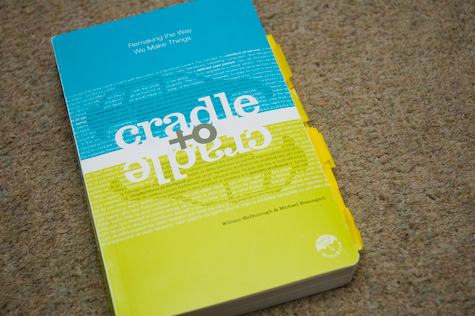
It’s an exciting book, if only because the physical artefact embodies its message:

cradle-to-cradle.jpg

Cradle to Cradle is not made out of paper, you see. It’s a format called Durabook. The Durabook is made of a kind of plastic, and is entirely waterproof. More interestingly, it’s entirely reusable – the ink can be easily removed to allow reprinting or notebook use, and the “paper” itself can be melted down and reused without giving off toxins. It’s a good environmental citizen, essentially: reusable, up-cyclable, and with no harmful byproducts. (It’s also surprisingly heavy for such a slim format).

I found it an interesting read. I found a lot of their later commentary on designing services probably the most interesting and relevant – a lot of discussion on refactoring products (which, by their nature, are designed for disposal) into services (wherein the product can be upcycled or removed from the equation, as it’s the service that matters). The Linc concept mobile phone is a good illustration of the thinking the book suggests.

At times, though, I found it depressing; a lot of the innovations pointed to are McDonough and Braungart’s own, and it would have been good to see more examples from people other than them. Similarly, at times the scale of the challenges described in the book seems colossal, and perhaps impossible.

But I think, taken with a pinch of salt, it’s an interesting read, and there’s some good meat within it. With that in mind, here’s what I marked out for myself as being interesting:

p.24, on Henry Ford’s innovations:

“In 1914, when the prevailing salary for factory workers was $2.34 a day, he hiked it to $5, pointing out that cars cannot buy cars. (He also reduced the hours of the workday from nine to eight). In one fell swoop, he actually created his own market, and raised the bar for the entire world of industry.”

I really enjoyed the section on Ford. They point out that a lot of Ford’s innovations really were more environmentally-friendly than the wasteful, inefficient factories that had preceded them. This doesn’t make it good, per se, but it’s worth bearing in mind. And I love “cars cannot buy cars”.

p.46, on the sentiments of the American Pastoral writers:

“[Aldo] Leopold anticipated some of the feelings of guilt that characterise much environmentalism today:
“When I submit these thoughts to a printing press, I am helping cut down the woods. When I pour cream in my coffee, I am helping to drain a marsh for cows to graze, and to exterminate the birds of Brazil. When I go birding or hunting in my Ford, I am devastating an oil field, and re-electing an imperialist to get me rubber. Nay more: when I father more than two children I am creating an insatiable need for more printing presses, more cows, more coffee, more oil, to supply which more birds, more trees, and more flowers will either be killed or … evicted from their several environments.”

p.60, on the struggle between what Jane Jacobs described as commerce and the guardian:

“Any hybrid of these two syndromes Jacobs characterizes as so riddled with problems as to be ‘monstrous’. Money, the tool of commerce, will corrupt the guardian. Regulation, the tool of the guardian, will slow down commerce.”

p.61, on regulation being a signal of design failure:

“In a world where designs are unintelligent and destructive, regulations can reduce immediate deleterious effects. But ultmiately a regulation is a signal of design failure. In fact, it is what we call a license to harm: a permit issued by a government to an industry so that it may dispense sickness, destruction, and death at an ‘acceptable’ rate.”

p.66-67, on sacrifice and “eco-efficiency” as a way of trying to cut down on the bad things humans do:

“In very early societies, repentance, atonement, and sacrifice were typical reactions to complex systems, like nature, over which people felt they had little control. Societies around the world developed belief systems based on myth in which bad weather, famine, or disease meant one had displeased the gods, and sacrifices were a way to appease them…

But to be less bad is to accept things as they are, to believe that poorly designed, dishonorable, destructive systems are the best humans can do. This is the ultimate failure of the ‘be less bad’ approach: a failure of the imagination. From our perspective, this is a depressing vision of our species’ role in the world.

What about an entirely different model? What would it mean to be 100 percent good?”

It takes them a while to get to that point (in a ~180 page book), but that’s the real kicking-off point for the more interesting arguments – by reframing the problem in a world that doesn’t have a concept of waste, what kind of answers emerge?

p.70, on rethinking the “entire concept of a book” (which is something the artefact of Cradle to Cradle itself does, as mentioned earlier):

“We might begin by considering whether paper itself is a proper vehicle for reading matter. Is it fitting to write our history on the skin of fish with the blood of bears, to echo writer Margaret Attwood?”

p.80, on “nature’s services”:

“Some people use the term nature’s services to refer to the processes by which, without human help, water and air are purified [...] We don’t like this focus on services, since nature does not do any of these things just to serve people.”

True “services” have to intend to service a particular need – you can’t just apply the s-word to any available substrate or process.

p.84:

“Western civilization in particular has been shaped by the belief that it is the right and duty of human beings to shape nature to better ends; as Francis Bacon put it, ‘Nature being known, it may be master’d, managed, and used in the services of human life.‘”

p.87, on new approaches to zoning:

“We agree that it is important to leave some natural places to thrive on their own, without undue human interference or habitation. But we also believe that industry can be so safe, effective, enriching, and intelligent that it need not be fenced off from other human activity. (This could stand the concept of zoning on its head; when manufacturing is no longer dangerous, commercial and residentail sites can exist alongside factories, to their mutual benefit and delight.)”

That would make Sim City interesting.

p.88; professor Kai Lee talks to members of the Yakima Indian Nation about the long-term plans for storing nuclear waste within their territory.

“The Yakima were surprised – even amused – at Kai’s concern of their descendants’ safety. ‘Don’t worry,’ they assured him. ‘We’ll tell them where it is.’ As Kai pointed out to us, ‘their conception of themselves and their place was not historical, as mine was, but eternal. This would always be their land. They would warn others not to mess with the wastes we’d left.

We are not leaving this land either, and we will begin to become native to it when we recognize this fact.”

This reminds of Tom Coates’ Native to a Web of Data – we will become native to the web when we recognise that the data structures we create and impose on it will stick around forever, and that we should design them as such.

p.102, on “deflowering” a new product:

“Opening a new product is a kind of metaphorical defloration: ‘This virgin product is mine, for the very first time. When I am finished with it (special, unique person that I am), everyone is. It is history.’ Industries design and plan according to this mind-set.”

p.103:

“What would have happened, we sometimes wonder, if the Industrial Revolution had taken place in societies that emphasize the community over the individual, and where people believed not in a cradle-to-grave life cycle but in reincarnation?”

p.104, describing the two discrete metabolisms of the planet:

“Products can be composed either of materials that biodegrade and become food for biological cycles, or of technical materials that stay in closed-loop technical cycles, in which they continually circulate as valuable nutrients for industry. In order for these two metabolisms to remain healthy, valuable, and successful, great care mus be taken to avoid contaminating one with the other.”

p.120: fittest vs fitting-est

“Popular wisdom holds that the fittest survive, the strongest, leanest, largest – perhaps meanest – whatever beats the competition. But in healthy, thriving natural systems it is actually the fitting-est who thrive. Fitting-est implies an energetic and material engagement with place, and an interdependent relationship to it.”

p.128, on misunderstanding Le Corbusier’s intent:

“Modern homes, buildings, and factories, even whole cities, are so closed off from natural energy flows that they are virtual steamships. It was Le Corbusier who said the house was a machine for living in, and he glorified steamships, along with airplanes, cars, and grain elevators. In point of fact, the buildings he designed had cross-ventilation and other people-friendly elements, but as his message was taken up by the modern movement, it evolved into a machinelike sameness of design.”

p.144, on people’s affinity for certain types of visual:

“According to visual preference surveys, most people see culturally distinctive communities as desirable environments in which to live. When they are shown fast-food restaurants or generic-looking buildings, they score the images very low. They prefer quaint New England streets to modern suburbs, even though they may live in developments that destroyed the Main Streets in their very own hometowns. When given the opportunity, people choose something other than that which they are typically offered in most one-size-fits-all designs: the strip, the subdivision, the mall. People want diversity because it brings them pleasure and delight. They want a world of [paraphrasing Charles De Gaulle] four hundred cheeses.”

p.154, on criteria for new product design:

“High on our own lists [of criteria] is fun: Is this product a pleasure, not only to use, but to discard? Once, in a conversation with Michael Dell, founder of Dell Computers, Bill observed that the elements we add to the basic business criteria of cost, performance, and aesthetics – ecological intelligence, justice, and fun – correspond to Thomas Jefferson’s ‘life, liberty, and the pursuit of happiness’. Yes, Dell responded, but noted we had left out a most important consideration: bandwidth.”

p.172, on the aspects of marketing and selling eco-friendly products:

“A small but significant number o consumers chose to buy the lotion in a highly unattractive ‘eco’ package shelved next to the identical product in its regular package, but the number who chose the ‘eco’ package skyrocketed when it was placed next to an over-the-top ‘luxury’ package for the very same product. People like the idea of buying something that makes them feel special and smart, and they recoil from products that make them feel crass and unintelligent. These complex motivations give manufacturers power to use for good and for ill. We are wise to beware of our own motivations when choosing materials, and we also can look for materials whose ‘advertising’ matches their insides, again as indicative of a broader commitment to the issues that concern us.”

p.185, in a section on “preparing for the learning curve”:

“Biologist Stephen Jay Gould has captured this concept nicely in a way that can be useful to industry: ‘All biological structures (at all scales from genes to organs) maintain a capacity for massive redundancy – that is, for building more stuff or information than minimally needed to maintain an adaptation. The ‘extra’ material then becomes available for constructing evolutionary novelties because enough remains to perform the original, and still necessary, function’. Form follows evolution.”

And that’s all, really. I enjoyed it a lot – though I found its message difficult and overfacing at times, and the perspective perhaps a little smug, there was lots of good stuff in it and it provided food for thought. Thanks to Tom for letting me borrow it, and to Mike for the format this blogpost takes.

Links & notes for this month

Endnotes