-
"This is a cross between Minesweeper and an RPG. You gain levels by killing weak monsters and win when you defeat them all. It's a bit different than Minesweeper in that the number you reveal when you click on a square is the total of the levels of the monsters in adjacent squares." Uh-oh.
-
"His earliest revelation about how the TV medium worked—one that heavily influences Community—came courtesy of a Cheers board game he spotted at a toy store. He realized that the characters were so relatable and their dynamics so clearly defined that anyone could step into their lives—even in a board game." Brilliant interview with Dan Harmon – but this paragraph really leapt out at me.
-
An unexpected place for a Le Guin interview, but it's great nontheless.
A quick guide to Inspector Spacetime
30 September 2011
So: a new season of Dan Harmon’s marvellous Community has begun in the US. It’s a very, very funny sitcom. It’s also a very funny sitcom that frequently plays on the expectation that the audience is deeply versed in pop culture, with entire episodes that pastiche movies and genres. You should watch it.
In S03E01, which aired last week, Abed – the TV geek inside the show – is distraught that his favourite show (Cougar Town) has been moved to mid-season – “never a good sign“. Afraid it’ll be cancelled, his friends try to find him a new favourite show. And, eventually, they stumble upon “a British sci-fi show that’s been on the air since 1962“:
Inspector Spacetime.
This is already a fairly brilliant joke – the phone box! The reboot-pastiching title card! And, you know, I hope it’ll return to haunt the rest of series.
But: then, the internet worked its magic.
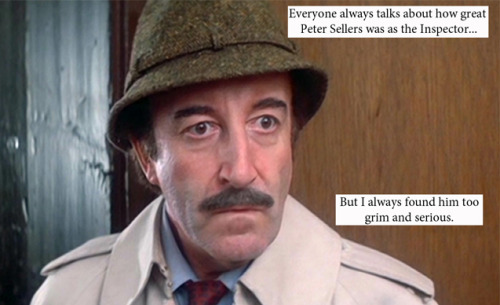
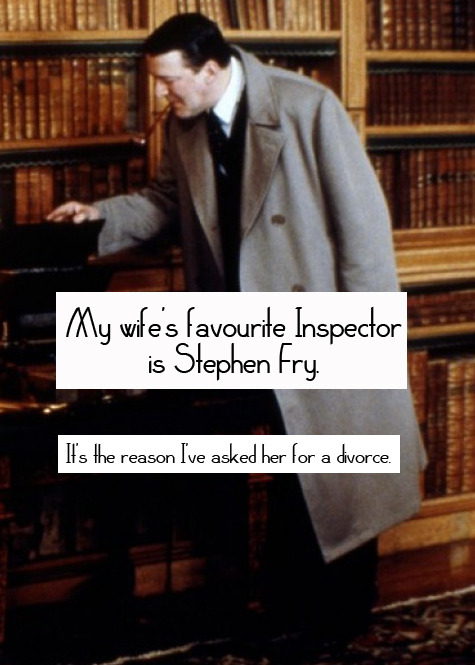
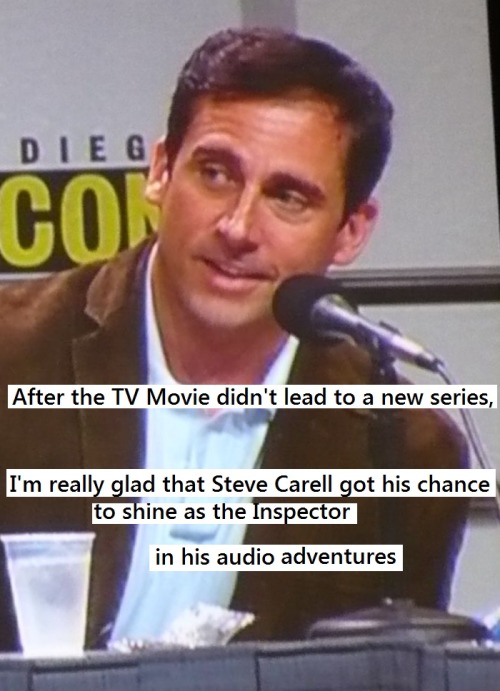
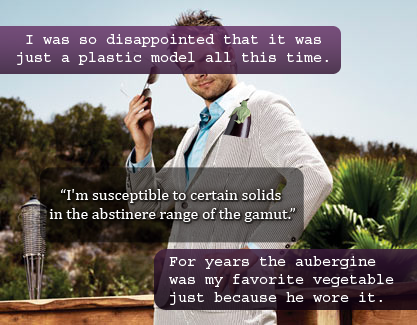
The thing that has been entertaining me beyond all measure this week is Inspector Spacetime Confessions.
This is a tumblr account of a popular format: the “Confessions” format, in which fans of TV shows, books, movies, etc, post “secret” confessions about their take on characters, episodes, or arcs (sometimes, secret crushes) as text written across images. Amateur photoshop at its best. It was huge on Livejournal, and it’s ideally suited to Tumblr.
Except: there are, currently, about fifteen seconds of Inspector Spacetime in existence.
This, of course, does not matter when you’re TV literate. What’s happened is: fans are just making it up. They’re back extrapolating an entire chronology based on fifteen seconds of “tone”, and their entire knowledge of the Doctor Who canon.
So, they’re diving into gags about former Inspectors:
They’re torn about Stephen Fry:
The Steve Carrell TV movie wasn’t well received:
And of course, they’re concerned about pocket fruit:
But there are more sophisticated jokes emerging. Like this one:

This presumes, in the form of a “fan confession”, that: the showrunner of Inspector Spacetime is also running another show – Hercule – which appears to be a modern-day Poirot reboot, and of course, because Benedict Cumberbatch is starring in Hercule, he’ll never be the Inspector.
This is sophisticated on a bunch of levels, but its elegance is in the way that entire gag is contained in one sentence and a photograph.
Or how about this:

which presumes Inspector Spacetime lives in that land of fictional TV shows, and thus a fictional actor (Alexander Dane) who starred in Galaxy Quest really ought, one day, to return to SF as the Inspector.
There’s a slowly emerging canon, thanks in part to the Inspector Spacetime forum. A lot of the canon is useful – the DARSIT feels better than the CHRONO box, everyone’s sold on Fee-Line – but it’s sometimes nice to see people buck it, or introduce new ideas (and Inspectors) in the most throwaway of Confessions. All this, from a fifteen-second joke that we don’t know will continue (or if it’ll introduce continuity we don’t know about yet).
And yes, Dan Harmon knows about it.
In the week between the two most recent episodes of Community, this has given me a vast amount of joy; I’ve been rattling the various configurations of Inspectors and Associates in my head, trying to remember my favourite episodes of a sci-fi show that never existed. And then giggling at the ingenuity and brilliance of some of the other confessions appearing – of the whole fictional history they bring to life, of Liam Neeson’s run in the 80s or the creepiness of the Laughing Buddas.
It’s really hard to explain the joy (especially as someone fascinated by the inner workings of serial drama) that this brings me. It’s a funny kind of magic – it’s unofficial, didn’t happen on TV, and just relies of fans’ understandings of not only TV shows, but how telly itself works. The results are just brilliant.
I’m off to write my own confession now. There’s always room for one more.
-
"On my way home from FOO I sat staring out the car window, all of these impressions, ideas, and seeming contradictions bouncing around in my head. And then something occurred to me. O’Reilly’s human-centered approach is still a kind of systems thinking. O’Reilly is still building a model of what the geek world is working on. They’re just doing it through the social relationships that their employees form with other geeks. The “data” they gather is stored in their employees heads and hearts and in those of the wider community of geeks they bring to events like FOO. Instead of trying to live in the model, O’Reilly tries to live in the community."
-
"I keep reading books and seeing movies where nobody can fucking say anything except fuck, unless they say shit. I mean they don’t seem to have any adjective to describe fucking except fucking even when they’re fucking fucking. And shit is what they say when they’re fucked. When shit happens, they say shit, or oh shit, or oh shit we’re fucked. The imagination involved is staggering. I mean, literally." Ursula LeGuin on obscenity, swearing, and the way it's used on contemporary media. (LeGuin is someone who, for reference, has always used language precisely and carefully; she is not a prude, just bored of a lack of imagination.)
-
This large image (4400×2364 pixels) is completely marvellous: a genuine history, reaching back into trends from the dawn of literature, and with a healthy chunk of 19th century gothic/mystery in there. Makes me very happy, especially in terms of fond memories of books I've enjoyed.
-
"The first 5 summoners who received 1+ week suspensions who reply to this thread – I will reply to your post with additional details explaining the suspension." Great thread: trollers and griefers ask to know why they received bans, understanding that the complaints against their names will be revealed in public. Then, some of them appear confused as to precisely why their crimes were considered so. Interesting piece of transparency from the LOL staff.
-
Shutterbug vs the Super Metroid soundtrack, from the new Team Teamwork joint. Oh yes.

-
"In their wisdom Sega had connected the console’s power board to the console with six wibbly-wobbly pins and made the disc tray’s lid switch from wishes. Dummying data to the edge of the CD was the least you could do for the asthmatic old dear’s clunking and whining laser." Wonderful piece from Five Players on Dreamcast piracy – and how the pirate community kept life in an undersupported piece of magic.
-
Jonathan Blow's game prototypes; some interesting stuff here, especially in the READMEs.
-
"Please don’t believe any of this. Go instead to the data and have a look for yourself." Which is, for this audience, a very good way of putting it.
-
"In [Nude] she was always sorry for the clumsy pins, and the uneven parting in her hair. But Edward Weston regretted the shadow on her right arm, which spoiled the symmetry of her body curving like an architectural form or a tree, or like a curling wave on the coast, lines as lovely as any in Nature. To her lasting astonishment, he had glorified her." I love Economist obituaries, and this one – of Charis Wilson – is no exception. Lovely.
-
"All the characters fom Home Alone, the project starts on the 22nd." 22 Twitterbots, performing Home Alone, in realtime, starting Dec 22nd. Awesome. Bonkers, but awesome (and takes the concept I used in Twit 4 Dead to a new level).
-
"The whisky social network". Ooh. Has potential, at least.
-
'"We studied these online gangs at the same time I was looking at the offline gangs and it turned out the model we were developing to explain the behaviour of the online guilds began to coincide with the offline gangs," says Johnson. "We could explain the data using the same mathematical ideas."' Which all makes sense, you know, but it's still interesting to see this stuff being done and taken seriously.
-
"In this project, we consider the problem of reconstructing entire cities from images harvested from the web. Our aim is to build a parallel distributed system that downloads all the images associated with a city, say Rome, from Flickr.com. After downloading, it matches these images to find common points and uses this information to compute the three dimensional structure of the city and the pose of the cameras that captured these images. All this to be done in a day." Woah.
-
"This is my boot fetish Pong game". I first saw James at OpenTech demonstrating his prawn-sandwich powered BBC Micro clock. It is good to know he is still building brilliant things. And: more Ellie Gibson interviews in the world is never, ever a bad thing.
-
Russell on Joe Moran's new book, which I'm clearly going to have to read.
-
Matt Haughey on ten years of MetaFilter.
-
"Dyack’s controversial message was delivered during a talk at Brighton, UK's Develop Conference calling for games to be considered as "the Eighth Art." He highlighted the writings of Ricciotto Canudo, an Italian author and one of the first theorists of film who considered cinema to be the Seventh Art." More to come on this – because I was there and disagreed a lot. That said, Dyack was interesting – I just don't think he's correct. This is mainly because he's adapting the writings of someone writing film theory for people new to film, as opposed to the film theory that happens when the audience understand it.
-
"Apple thinks this is good enough. And that’s the scariest part of all." Marco explains why.
-
"Here are nine individuals who know more than you do about some elements of online communities – even if they couldn’t necessarily put it in writing." How did I miss this the first time around?
-
Now that Net Yaroze has closed its doors, Edge catch up with some former Yaroze developers; they have some interesting things to say on the state of games education in particular.
-
"[Our heroine's] name is Marta Louise Velasquez, and she’s quite possibly the most unpleasant female lead character in the history of gaming. She’s also what makes TD2192 worth remembering." Indeed, I have many. She did not lead a happy life, I'll give Richard that.
-
"Critical thinking is the key to success!" Professor Layton is on Twitter. Officially. This is good.
-
why do it? To borrow from the site's About pages: "First, it will help you find shows that others have not only watched, but are talking about. Hopefully it'll throw up a few hidden gems. People's interest, attention and engagement with shows are more important to Shownar than viewing figures; the audience size of a documentary on BBC FOUR, for instance, will never approach that of EastEnders, but if that documentary sparks a lot of interest and comment – even discussion – we want to highlight it. And second, when you've found a show of interest, we want to assist your onward journey by generating links to related discussions elsewhere on the web. In the same way news stories are improved by linking out to the same story on other news sites, we believe shows are improved by connecting them to the wider discussion and their audience." Dan Taylor explains Shownar from the BBC's perspective
-
"Shownar tracks millions of blogs and Twitter plus other microblogging services, and finds people talking about BBC telly and radio. Then it datamines to see where the conversations are and what shows are surprisingly popular. You can explore the shows at Shownar itself. It’s an experimental prototype we’ve designed and built for the BBC over the last few months. We’ll learn a lot having it in the public eye, and I hope to see it as a key part of discovery and conversation scattered across BBC Online one day." Matt talks about Shownar on Pulse Laser.
-
"Shownar tracks the online buzz around BBC shows. It's an experimental prototype and we want your feedback." What I've been working on in the first three months at Schulze & Webb, and is now live. Exciting!