-
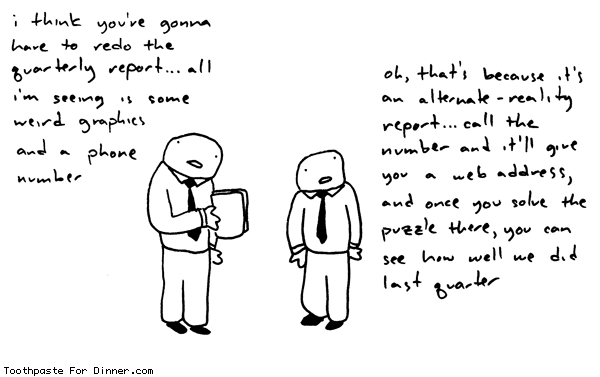
"Oh, that's because it's an alternate reality report…"
-
"The point here, is that the flickr team did not wake up one morning and think: “You know, if we captured THIS kind of data, we could create this mashup; so let’s create an application.” Instead, they re-used data they were already capturing, and brought out something very interesting indeed. By creating tools which match their data (and could be used with other data of the same kinds), flickr is able to expose layers of value from the rich-pickings of their own data-cloud. The good stuff is where the data are." Yes, it is.
-
"Some people love this kind of aggregation. Good for them. I, however, am human and my eyes glaze over when trying to comprehend a chronological stream of equally-weighted events, a format only robots could love. This is rubbish… There must be better ways of showing such “here’s what I’m up to” information." Phil talks about some problems he's been trying to solve with dashboard displays.
-
"A magnificent, huge orca-like beast, swimming calmly through the vast ocean beneath my smoke-belching craft. She was a beauty. And she instantly became my Moby Dick. “I’m coming back for you”, I thought. Big Shirl is a reason to reach level 80. I have no doubt the grind will get to me before too long, or that the thought of repeatedly running the same dungeons or battlegrounds come level 80 will turn me off all over again… In these early days though, before everyone in it knows everything, it’s an explorer’s paradise. That’s why I play MMOs." A nice, thoughtful article from a first look at WotLK from Alec Meer
-
"Wow. Ever get the feeling you've been thrown for a loop? I did just that, when I worked out that GSW commenter and erudite game blogger, PixelVixen707, appears to be not just a smart game blogger, but a fictitious front for some kind of damn weird ARG/online story." Down the rabbit hole we go, again.
-
"SourceForge is about projects. GitHub is about people… This is a pivot of the traditional open source project website. A pivot from project to programmer. I love the pivot."
-
"At the start it seemed reasonable to think that Mirror's Edge could stand entirely on the merits of its brilliant core concept, and not need to include extraneous and negligibly attractive features to appeal to as many people as possible. But, no, this is the video game business." This is the stuff that's scaring me most about Mirror's Edge.
-
"…in recent years, [the stage has] moved away from those practices. Today, we better understand the importance of offering kids the very best we can do. They are no different from the rest of us. They respond positively to quality, and they quickly grow bored and restless with mediocrity… We might consider a similar approach to video games. If we want our kids – heck, if we want all of us – to enjoy quality games, we must pay attention to and promote those games that deliver quality."
-
From Duncan Harris; postcards from post-apocalyptic DC.
-
Course notes from Stanford's Cocoa programming course.
Katy, over at Kitschbitch, writes about Nokia’s new “transmedia” advertising campaign, and comments on it’s ARG-iness – or rather, its un-ARG-iness – and feels disappointed, saying:
…given that Nokia were the trailblazers of using immersive play to engage with consumers, doesn’t it feel like they’ve missed a bit of a trick here?
I was going to comment, but my comment grew and grew, and it felt like a post in its own right.
I’m not sure I’d agree with some of Katy’s criticisms. What’s emerged as a “traditional ARG” has basically consistently turned out to be very engaging for a tiny number of users, very costly to run, and usually exhausting for all concerned. They’re difficult to sustain and few companies ever go for a second ARG.
So a “campaign you can interact with” is a much more realistic interpretation of an ARG, you could argue: it requires far less involvement to get people in, meaning that your advertising dollar reachers more end users; it doesn’t require too much of a long term committment; it’s not community driven, meaning people can have the experience on their own, without having to invest time in building new relationships; whilst it’s interactive, it’s a constrained form of interaction, meaning it’s easier to control and keep on the rails.
The one thing it does have in common with an ARG is that it’s timeboxed: it runs for six weeks. Want to play it after those six weeks? Tough. That’s actually one of the biggest problems facing ARGs: getting away from that timeboxed nature.
So whilst it’s not the bleeding edge of ARG design, it’s probably a much more practical decision for an advertising division on Nokia: it’s less of a loss-leader than another Beast or ILoveBees; it’s engaging a broader degree of consumers but at a shallower level; it’s an order of magnitude or three less complex than a full-blown ARG.
I’m not necessarily convinced by the implementation, but I don’t think the lack of scope is reason for criticism per se; if anything, the “simple ARG” is perhaps harder to get right than the long, complex narrative that you can fix in retcon later on. The upfront budget – advertising, filming, media costs – here is bigger than most ARGs; the running cost is smaller. That sounds like a sensible way of keeping costs where you’re in control of them.
And so I think I’d argue that it’s actually more innovative than throwing a massive ARG budget at the problem: they’re trying to learn from ARGs to see what an affordable, practical interactive campaign, made by advertising/digital media agencies (rather than ARG agencies) might look like. That’s got to be worth a point or two.
-
"You have 1 point. 1 point is rubbish. You want more." Beautiful, fun-looking trailer for an XNA title due out next sure – that simultaneously captures what games are basically about. Or, at least, what points are all about.
-
"Wells has received insufficient credit as a writer of rhythmic, incantatory prose, long-breath paragraphs to cut against his tight journalistic reportage. The War of the Worlds makes the journey from sensationalist incident to moral parable. Wells predicts an era when fiction and documentary will be inseparable." Fantastic writing from Iain Sinclair on HG Wells.
-
"When a sospeso is ordered, the customer pays for two coffees, but only receives one. That way, when a person who is homeless or otherwise down on their luck walks into the café, the person can ask if there are any coffees held in suspense, and can have one as a courtesy of the first customer." Wonderful.
-
Wikipedia quotation of the day: "Variations of the red eye based on the number of espresso shots include the black eye, which is made with two shots of espresso, and the dead eye, which is made with three shots of espresso. A 'fight club' contains four shots of espresso." A "fight club"!
-
"You forgot one thing, Dr. Roberts. You forgot that people are dicks." Aheheh.
-
"Perhaps then what people object to, whether they realize it or not, is an ideological and theological issue with religious gaming, rather than any particular distaste as the idea Christian gamers might simply want games that explore their faith and service their community."
-
"So why am I mentioning this now? Because Alternity has just started. This is a new Harry Potter game, and it starts from the beginning — September 1, Harry's first day at school. Only not as in The Philosopher's Stone. In this scenario, Voldemort, er, won." Fanfic-cum-alt-universe-RPGs in the Potterverse being run solely on Livejournal. Amazing.
-
An interesting series of concept images of what context-aware, mobile search and data-diving tools might look like. Some neat thinking around transparency and context.
-
"I wanted to take portraits of people that would reveal a hidden part of their character. So I had them play videogames."
-
"Why did Weight Watchers work so well? For a really fascinating reason: because it isn't a normal diet. It's something more. Something fun. It's an RPG." Of course. Fantastic deconstruction from Clive Thompson.
-
Braid papercraft. Delightful.
-
Eesh. Tetris in 500 bytes of Javscript and HTML. Yes, they're obfuscated and unpleasant, but wow, etcetera.