-
"The solo would still sound great if he played it with stiffer sixteenth notes, in a pop rather than funk style. And the groove would work fine if the drum machine had a little more swing to it. But keeping the guitar swing in tension with the straight drum groove is real Jedi-master musicianship. Right before the solo starts, Prince sings, “Ahhh, think I wanna dance,” and that is exactly what it sounds like his fingers are doing." One of many highlights from a huge deep dive on yet another Prince guitar part that sounds like, you know, just a thing, but is a producer and player at the top of their game. Fitting that tiny thing into such a sparse track! Every time I listen to Prince, I wish I knew even more Prince, and when I'm reminded I know a lot of Prince, I wish I knew it _better_.
-
I like reading Robert Yang write about games. In particular, I like how he separates out "lessons learned" from analysis – the two can exist independently – and I enjoyed seeing him point out when you coudl "probably stop" playing a thing. Completion is sometimes overrated.
-
Simple looking timing library
-
Oh god this is like catnip. I am going to pore over this in a bit. The gifs are fantastic.
-
"Now that we know some of the problems, how does Curiosity solve it? The answer is: it does not. It saddens me but the game does not even appear to have realized what the problem with the design might be. The cleverness in the execution seems to stop after realizing that transmitting all the blocks at one time is a bad idea. Instead of looking at this as a form of interesting engineering problem nobody thought anything at any point…" Ouch. Great analysis of the problem, depressing analysis of the implementation. You'd really have thought game developers building a game around these very issues would have thought they'd have been critical to solve. Hey-ho.
-
"Parametric models indicate how a change to one component of a structure causes ripples of changes through all the other connected elements, mapped across structural loads but also environmental characteristics, financial models and construction sequencing. FC Barcelona's activity is also clearly parametric in this sense. It cannot be understood through sensors tracking individuals but only through assembling the whole into one harmonious, interdependent system: the symphony and orchestra, rather than the midfield string section, or Lionel Messi as the first violinist." A brilliant article from Max; finally, he's written his long-promised article on 'realtime sports graphics' and it's really excellent: insightful about football and data visualisation alike. Top stuff.
-
"To apply the same point to videogames, ‘we’ are exceptionally good at the analytic mode and extremely poor at the rhetorical persuasion. As a cohort, we’re remarkably analytical. There are not many writers, bloggers, critics, etc of videogames who are either committed to the persuasive communication of the veracity of their feelings, moods, and strange hunches about videogames, but there sure is a lot of people willing to point out the textual or dramaturgical features of XYZ latest game." This, many, many times over. It's one reason I tire of so much wordy criticism at the moment: it is exhaustive, but lacks direction. (This, for me, was the gap between my first years at university and my final year: finding the courage to make my own arguments, rather than just synthesizing everything around me).
-
"In principle, the pressure ought to be off, since you've got a infinitive lives and a stock of smart-bombs. In practice, the game quickly becomes so pulsingly busy that I not infrequently become blind to the position of my own ship. I'm still playing – still winning – but have no visual awareness of the bright white claw I'm actually steering. The bit of my brain that handles moving knows where it is, but the bit of my brain that does the thinking has no idea, and they very rapidly start screaming at each other." Margaret's new column for Gamasutra goes live (hurrah). Talking about this was one reason I got sucked back into Deadline very deeply a few weeks ago. Deep enough to edge beyond randomness, towards a semblence of mastery, and at least understand the system. At least enough to understand quite how fine it is.
-
This is great. Brandon is smart. And: when he says "story", he doesn't mean story. He just means "show me something new".
-
"National Geographic has closely documented the journey of the final roll of Kodachrome manufactured, down to its being processed. Dwayne's is only photo lab left in the world to handle Kodachrome processing, so National Geographic Television producer Yvonne Russo and National Geographic magazine senior video producer Hans Weise found themselves in Parsons Monday, along with McCurry, with the final roll of the iconic film of the 20th century." Steve McCurry shot the final roll of Kodachrome in the world.
-
Jeffrey does that hard work so you don't have to. I'm going to leave my slider set around 75, but it's still good to know what the hell is (vaguely) going on under the hood…
-
"In this post I present the development model that I’ve introduced for all of my projects (both at work and private) about a year ago, and which has turned out to be very successful. I’ve been meaning to write about it for a while now, but I’ve never really found the time to do so thoroughly, until now. I won’t talk about any of the projects’ details, merely about the branching strategy and release management." It's a detailed strategy, but well thought-through; I'm certainly going to bear some of this in mind in future (and, indeed, the way the release branches are handled is familiar).
-
More brilliant data-analysis and writing from OkTrends – perhaps my favourite data-blog out there, and one of my favourite discoveries in 2010 so far.
-
"I suppose there are multitudes of people to be 'drawn' by promising to show them what the city of a hundred years hence will be like. It was, I thought, an unresponsive audience, and I heard no comments. I could not tell from their bearing whether they believed that Metropolis was really a possible forecast or no. I do not know whether they thought that the film was hopelessly silly or the future of mankind hopelessly silly. But it must have been one thing or the other." He did not like it too much.
-
"Unless your surname's Coren you're going to need some help getting into the journalism industry." Great advertising from the Press Gazette
Eurogamer in 2009: Score Analysis
18 January 2010
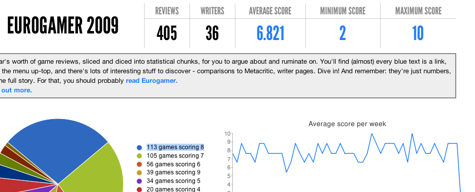
I really liked last.fm’s end-of-year charts. I also really liked this analysis of Pitchfork’s scoring in 2009, just for the statistical fun. And then I thought about my favourite score-oriented website, and wondered why no-one’s done this for Eurogamer yet. I’d be the first to argue that scores in reviews aren’t that important – but everybody loves arguing about them in comments threads, and besides, they make for interesting statistics. What I’d really like would be something like the Pitchfork analysis, but looking a bit more like the last.fm site.
And then after two days I just decided to build it myself.
It’s relatively straightforward: a small app to explore a year’s worth of review scores, built around the pillars of reviews, writers, and scores. Most blue things are clickable; writers have pages that show their reviews, as well as their own averages, deviance from EG’s norm, and the scale of their contribution to the overall average. That latter figure is something I call influence; it took a long while to get to, and I write about it more here. Here’s Simon Parkin’s page as a good example of a writer’s page.
Reviews also have pages – here’s one for Modern Warfare 2, which show how the review compares to the site’s average, the writer’s average, and also to Metacritic. And, of course, you can see just how many games scored 7 – or any other score – if you want. Basically: have a click around.
I started two weeks ago, and guess I stopped committing in the middle of last week, but towards the endit was just front-end tweaks. It’s not been a big project at all – about an hour or two’s work a day on average, in evenings, and lunch-hours, over about ten days.
It’s not a very advanced project, and touches lots of bases I’m working with a lot right now – data analysis, visualisation, scraping. That said, it’s got some interesting stuff under the hood. I’m using Typekit for the attractive type, and it’s been a pleasure to work with. The graphs are a combination of the Google Charts API and gRaphaël, which I’ve had reasonable results from recently. gRaphaël’s strength are beautiful visualisations, rather than ultra-accurate charting, so the pair of tools are used for their strengths. Finally, it’s all deployed on Heroku, which has been a joy as ever; cloud deployment of databased apps, on dynamic hosting, as simple as pushing to a new git repo. And, for the scale of the Eurogamer tool, totally free.
So there you go. A little exploration of some numbers, which bring some interesting figures to light, and was also fun to build. It only felt right to share it. As the site says, scores aren’t everything – you should read reviews too, folks – but when you’ve got numerical data, it seems a shame not to do anything with it.